
Uber: The Market Is Wrong, Time to Buy!
Fears of disruption has created one of the most attractive buying opportunities in the market right now.

If I were to reduce how to succeed in the market to one sentence, I would refer to great Charlie Munger and say just one sentence—buy the best companies possible.
Indeed, if you can just buy the best companies, the chances are great that you will make satisfactory returns over the long-term even if you initially overpaid.
Naturally, if you can somehow manage to buy them at bargain prices, your returns will be greatly magnified.
Look at the most successful investors of our time, and you’ll see they all have somehow touched on the concept of exceptional company + bargain price + long horizon:
Joel Greenblatt: “Buying good businesses at bargain prices is the secret to making lots of money in the market.”
Phil Fisher: “Finding the really outstanding companies and staying with them through the good and bad is way better than the old advice of buying cheap and selling dear.”
Charlie Munger: “It’s far better to buy a wonderful company at a fair price than a fair company at a wonderful price.”
The problem is that finding these companies at bargain prices is very hard.
Indeed, once something is exceptional, it rapidly becomes well-known. After all, the best burger in town doesn’t stay a secret forever.
Thus, these companies rarely trade at bargain prices.
In Buffettology, Warren’s ex-daughter-in-law Mary Buffett says that Warren looks for three occasions to find exceptional businesses at bargain prices:
General market crashes
Industry-wide recessions
Company-specific concerns
Indeed, these three situations used to be great fishing ponds to find exceptional companies at bargain prices. However, this has changed as the market has become increasingly sophisticated.
After observing companies like Microsoft, Apple, Amazon, Google, and Meta for decades, the market has now internalized the incredible longevity of exceptional businesses. Thus, exceptional companies now tend to stay strong during crashes, and their premiums rarely fully erode.
Take a look at Microsoft.
During the dept of the 2022 crash, despite a violent erosion in its massive premium, Microsoft was still trading around 22x forward earnings.
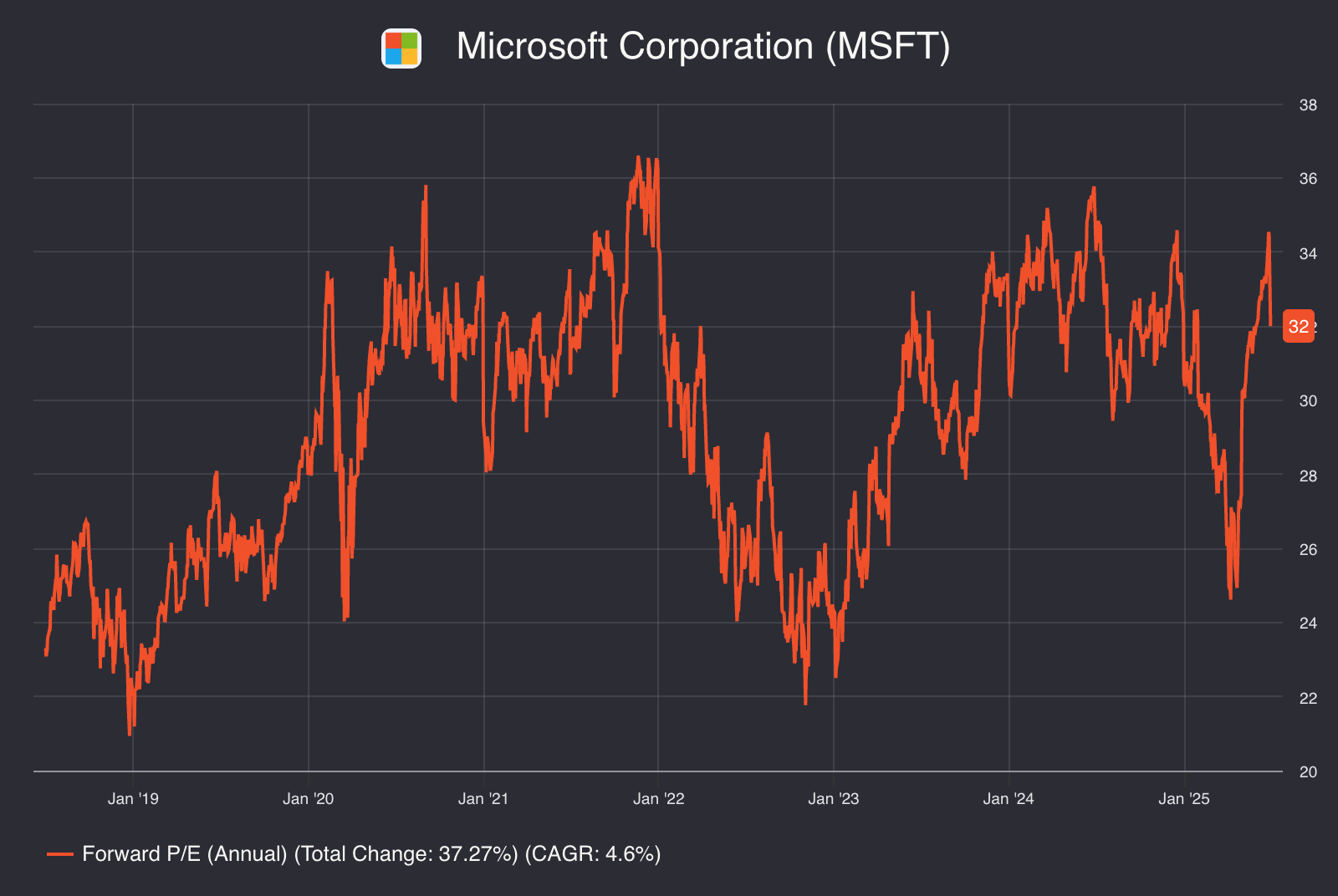
Industry recessions also rarely affect these businesses as they are largely non-cyclical. This is one of the defining elements of exceptionality. Look at the Covid-19 dip on the chart above. The whole world would shut down, but Microsoft was still above 20x forward earnings.
That only leaves one case: Company-specific concerns.
In today’s markets, that’s the only time we can find exceptional businesses at bargain prices. That fear could relate to real problems the business is having, potential problems, or uncertainties relating to the future, or perception of uncertainty.
Indeed, Meta in late 2022 was perhaps the biggest bargain we have seen in an exceptional business. At some point, it was trading at 12x forward earnings.
Fear about the future of the business is the one case we can find exceptional businesses at bargain prices these days.
That’s when a generational opportunity window opens for investors. When this happens, our duty is to look at the business, assess it independently from the noise, and decide whether the fears are justified or not.
If you can make the right choice here, rewards will be great.
Again, take Meta 2022 as an example. Fear was emitted from three sources:
Its cash burn from Metaverse investments.
Rise of rival platforms like TikTok.
Slower user growth.
At the time, if you looked beyond the surface, you could see that:
Metaverse investments could be cut at will.
Rival platforms were nowhere near the Meta ecosystem.
Slower user growth stemmed from saturation, not disengagement.
You could easily see that user growth would likely be slower, but top-line could still grow fast as Meta was under-earning per user relative to its potential. Most importantly, Meta would not be disrupted any time.
I bought the stock and made 5x on my investment in 18 months.
This is not something new or genius; it’s what smart investors have always done.
Warren Buffett bought American Express after the Salad Oil Scandal in 1963.
Bill Ackman bought Chipotle when it was struggling with food safety issues.
Nick Sleep bought Amazon when investors were afraid of margin compression.
They all worked out pretty well and built massive wealth for these investors. These openings come rarely, and if you can make the right decision, they pay off dearly.
Today, investors have similar concerns about Uber.
Investors are worried that robotaxi businesses like Waymo and Tesla will hit its mobility business, and possibly disrupt it in the medium term.
Result? The stock is now down 25% from its highs and 16% YTD, and it’s now trading at just 16x 2027 earnings despite growing 16% over the last twelve months.
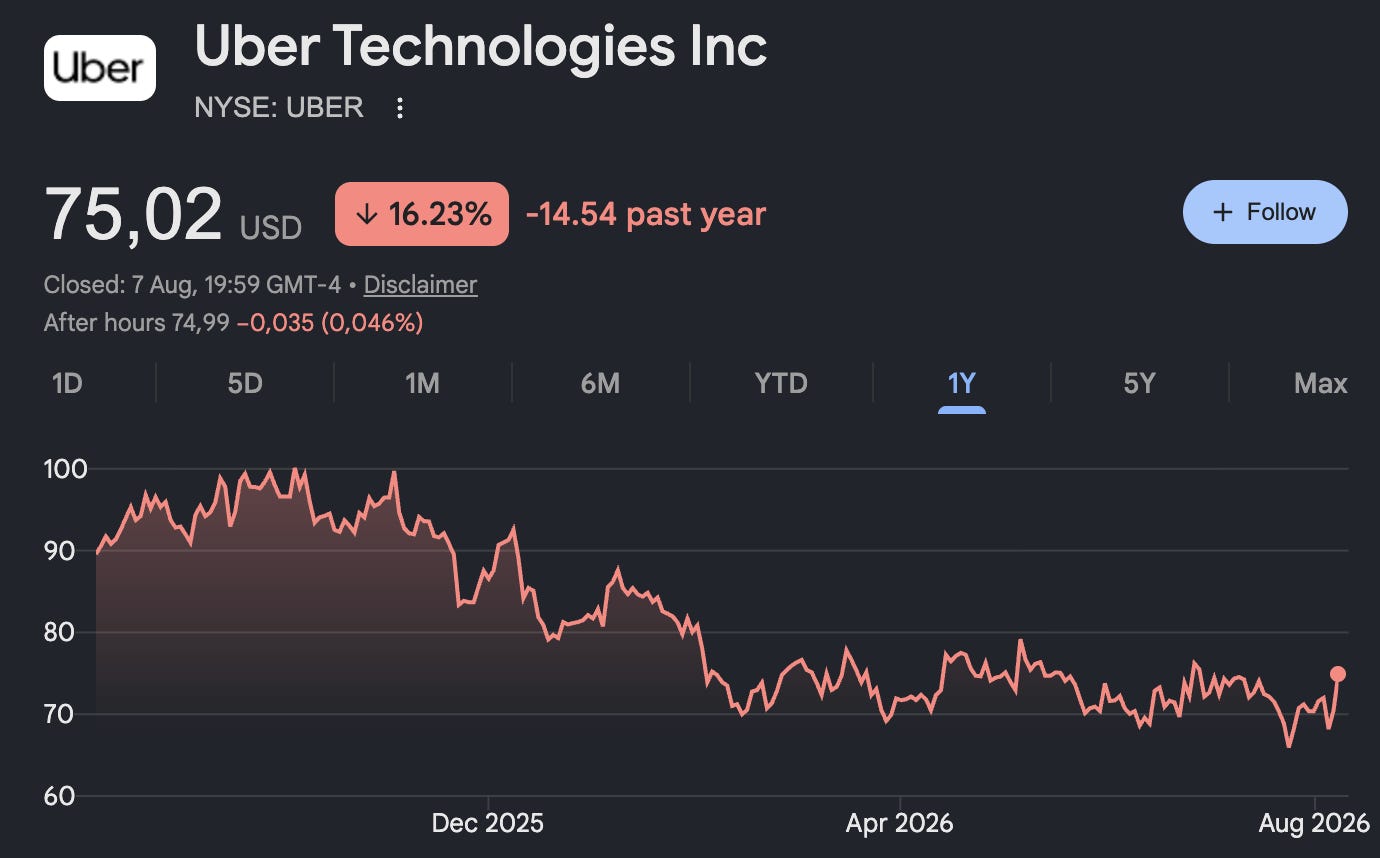
This is one of those openings where we could be looking at a generational opportunity to buy an exceptional business at bargain prices.
Thus, our job as investors is simple—analyze and decide whether the fears are based.
If no, buy; if yes, stay away; if hard to decide, stay away.
This is what we are going to do today.
So, let’s cut the intro and dive deeper into this!
What are you going to read:
1. 🏭 Understanding The Business
2. 🏰 Competitive Analysis
3. 📝 Investment Thesis
4. 📊 Fundamental Analysis
5. 📈 Valuation
6. 🏁 Conclusion
🏭 Understanding the Business
Ben Thomson, a popular technology writer, published a short blog post titled “Aggregation Theory” and claimed that aggregation was how the big businesses won in the age of the internet. Instead of controlling the supply of scarce resources, aggregation aims to control the relationship with supply and demand.
Uber was one of his main examples to explain this.
His main idea was that the internet enabled third parties to own the relationship between the customer and supplier, in a way that also benefits the customer and the supplier.
He suggested that before the internet enabled aggregation, firms were trying to seize control of this relationship by vertical integration:
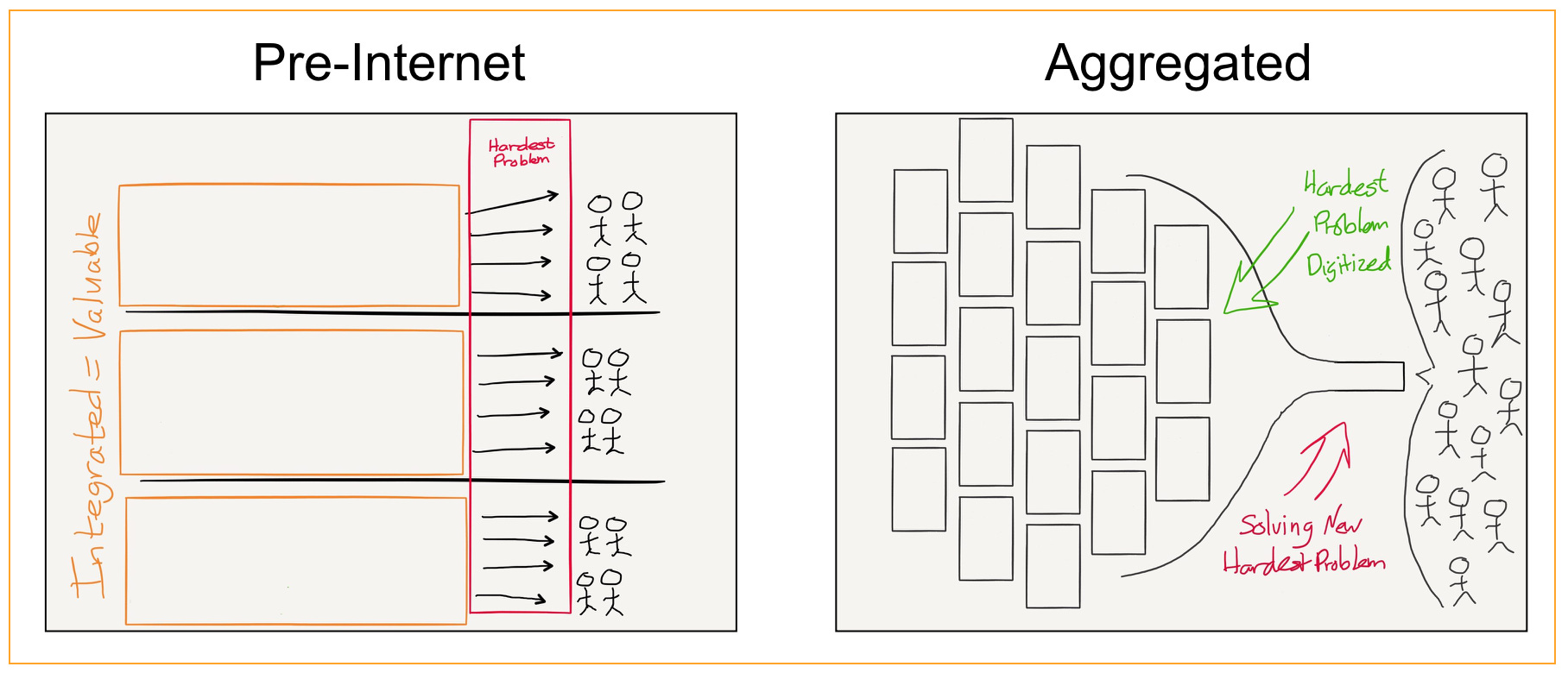
If you are very tech focused, you would think this is true and see aggregation as a digital native model. Worse, it could lead you to think of vertical integration as something at odds with aggregation, and this would affect how you think of Uber in the age of autonomy.
In fact, aggregation is a natural result of economic principles, supply & demand, and it’s as old as commerce itself.
The basic principle is as follows: When the supply and demand are generic, there are economic incentives for aggregation.
Generic demand means many people have it, and generic supply means there are many providers. Thus, at an individual level, matching is harder. A standalone shop in a neighbourhood can hardly attract customers with the same demand from other neighbourhoods.
This is why, over time, generic supply tends to concentrate in some region, so that customers from different regions flock there for options. As a result, demand also aggregates there to a degree that shops are better off there than they would be elsewhere even after accounting for generic competition.
Think about it.
This is why there are big Spice Bazaars in many countries on the old Spice Road. Each shop sells almost the same products. The bazaar is the aggregator, and it receives rents from the shops in exchange.
![Spice Market In Istanbul [Epic Spice Trade Center Of Turkey]](https://substackcdn.com/image/fetch/$s_!lTY8!,f_auto,q_auto:good,fl_progressive:steep/https%3A%2F%2Fsubstack-post-media.s3.amazonaws.com%2Fpublic%2Fimages%2F8be18e8d-e7fa-4859-9fe0-a9b8efe74bb6_2000x1347.webp "Spice Market In Istanbul [Epic Spice Trade Center Of Turkey]")
You can see this in almost all generic demand. Many cities have regions where jewellers are concentrated, for instance. Shopping malls themselves are also aggregators. They pack many shops together for many generic demands, and people flock there to satisfy several needs at the same time.
The fundamental question is why aggregating supply attracts demand? A standalone shop doesn’t attract demand, but when they come together, they magically do. How?
Aggregation of demand creates giant buyer power.
When a shop is competing with 50 other shops nearby, it can’t get away with higher-than-average margins, worse-than-average quality products, etc. Buyers sense this, and they go to those places to take advantage of the buyer power it offers.
This creates significant winner-take-all-or-most effects in the relevant geographic market as the total demand could be divided into only a few big enough groups. Markets get monopolized/oligopolized.
How many standalone shops are there in a mid-sized city? Thousands. How many shopping malls? Maybe 4-5, at most. They are aggregators.
So, unlike what Ben Thompson seems to have suggested, aggregation isn’t a new model. It’s as old as commerce.
What makes digital aggregators like Uber different from the older aggregation models is no physical limits on scale.
Aggregations like Grand Spice Bazaar, modern shopping malls, etc are physically limited. This has two implications:
Max amount of customers is capped.
Enhancing the potential is costly as it requires physical expansion.
For digital models, however, there is no limit on how many people can be served. You only need to expand the digital infrastructure, but once fixed costs are paid off, serving an additional customer costs almost $0.
This allows massive operational leverage to kick in over time as the company grows.
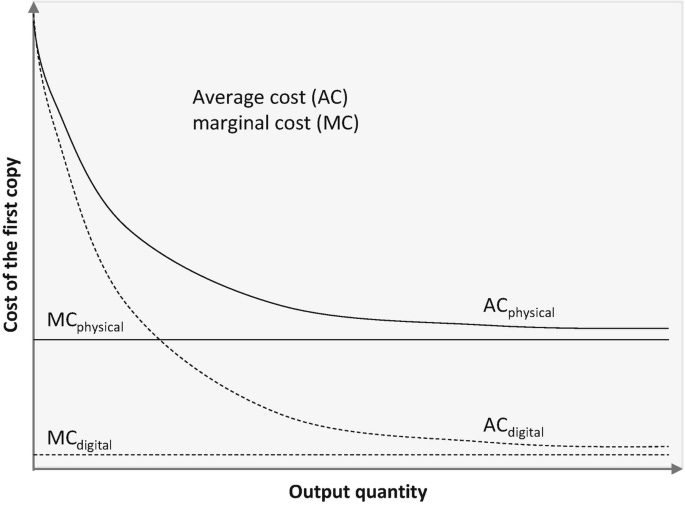
So, the first natural implication of no physical limits is no limit on customers that could be served.
There is also a second important implication: expansion to adjacent markets is also less costly.
Imagine Grand Spice Bazaar again. You know that most people coming there also need kitchenware. But there isn’t enough space to add kitchenware shops. No spice merchant would give its place, as they already have a stable business. Selling kitchenware requires expanding the architecture, which requires a lot of money.
For a digital aggregator that owns the customer relationship, however, it requires very little capital to expand into adjacent markets. And once expansion is made, the same aggregation economics work in the new market as well, i.e., unlimited physical scale, operational leverage, etc.
Today, we clearly observe both of these points with Uber.
Uber has built the largest mobility platform in the world that dominates ride-hailing in 72 countries as of early 2026:
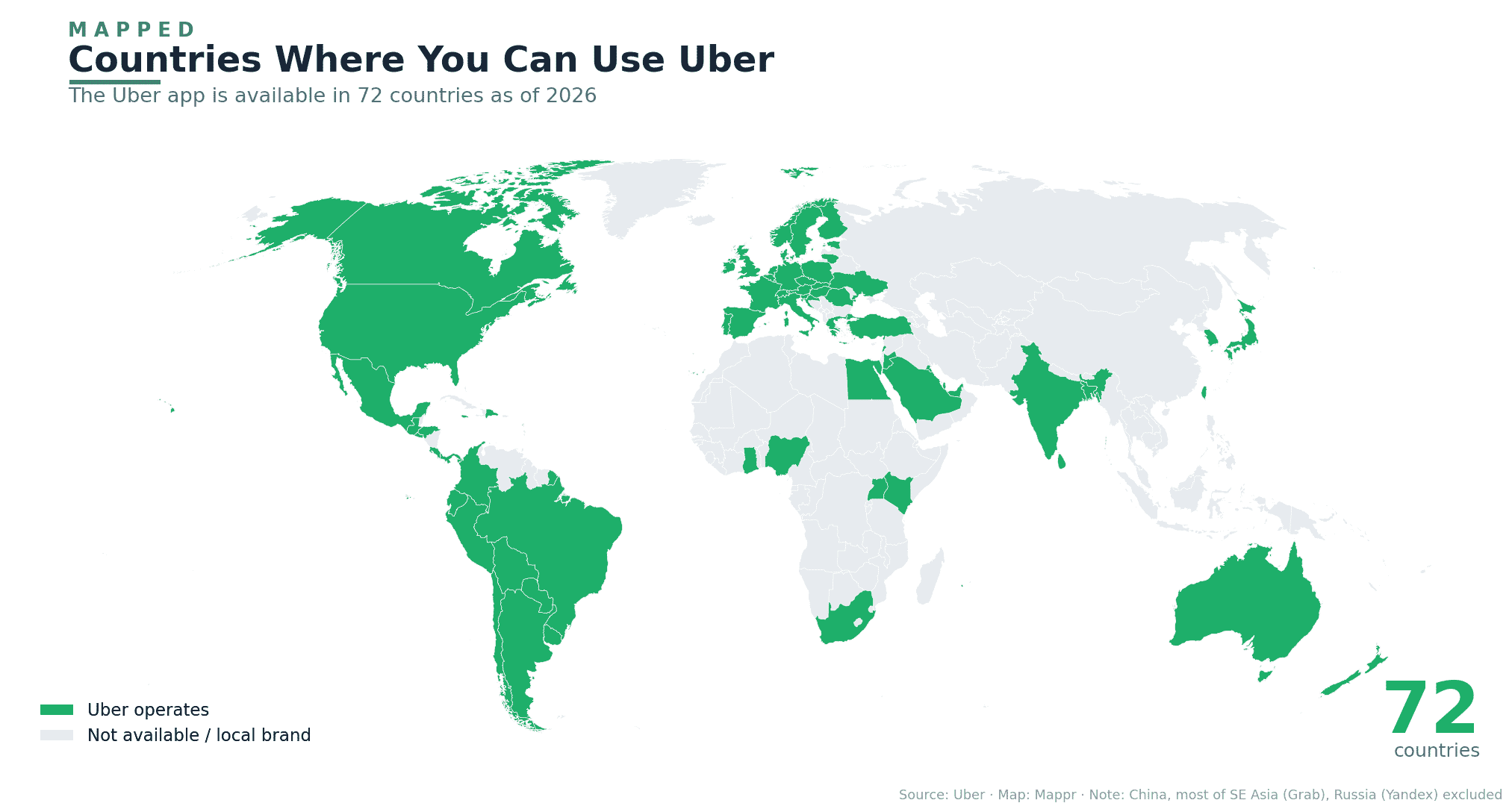
It currently has more than 200 million active monthly users, completes over 40 million trips per day, and has over 10 million workers on the platform.
Normally, let alone expanding to an adjacent market, serving over 200 million customers a month would be an unimaginable thing for a physical aggregation model like bazaars, shopping malls, etc. However, as we said above, the digital realm makes it very easy to expand into adjacent markets.
Uber has done exactly this and expanded into two adjacent markets—delivery and freight.
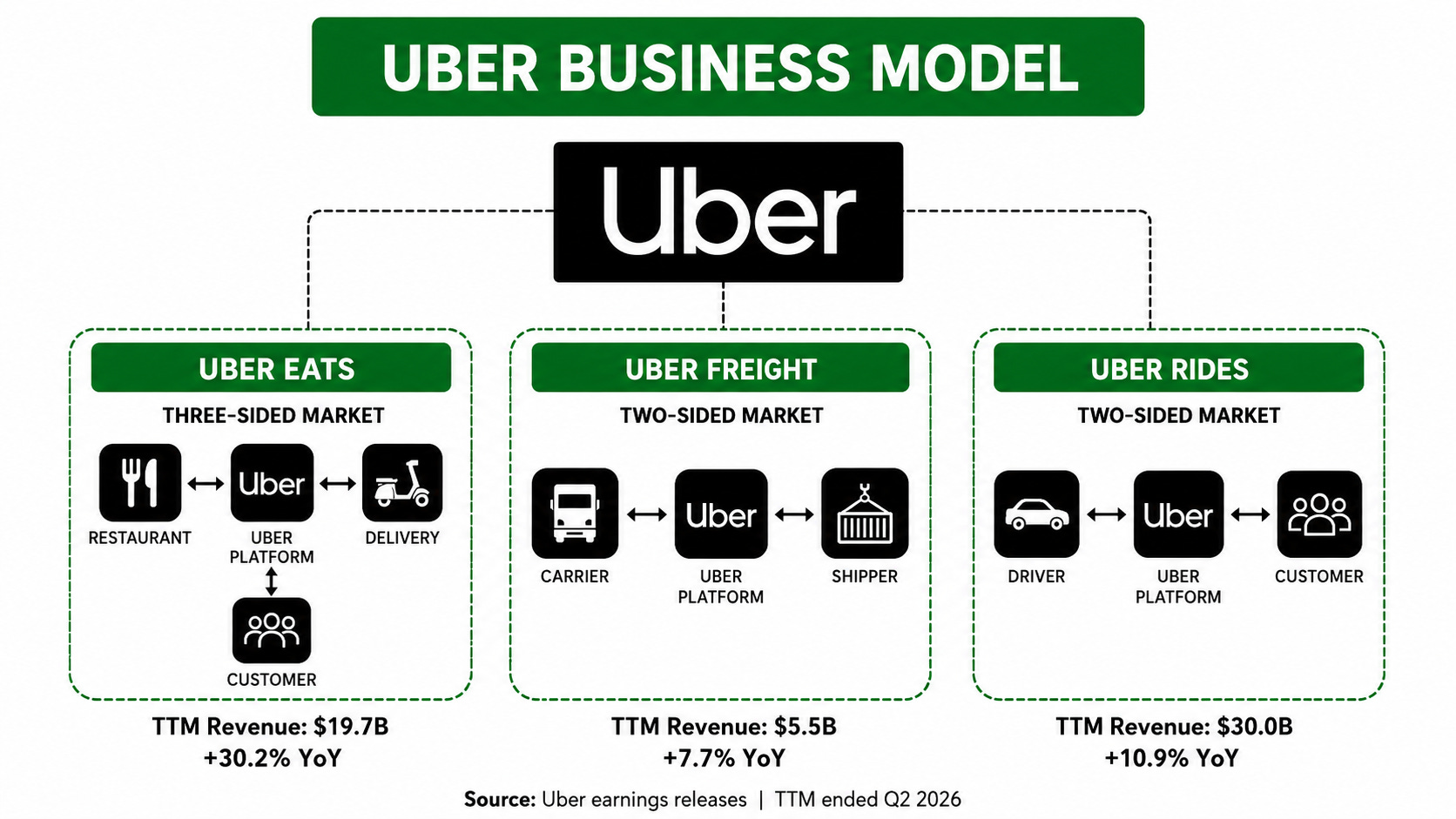
Though freight is an adjacent market, it’s not complementary to the other two, while delivery and mobility are complementary, which creates substantial platform synergies. Every mobility user is a potential delivery customer and vice versa.
Indeed, as of today, more than 30% of platform customers are active both in delivery and mobility, and this goes up to 40% for customers enrolled in Uber’s paid subscription loyalty program Uber One.
So, when we talk about Uber today, we are no longer talking about just a simple aggregator. It’s an aggregator that has managed to leverage its control over the customer relationship to expand in adjacent markets.
As a result, we are looking at an unmatched scale and scope.
On top of that, the services Uber aggregates are repeat in nature. People use mobility and delivery more than a few times a month.
When massive scale, scope, repeat orders, and near $0 marginal costs to serve are combined, we get an economic machine that is poised to generate massive cash flows year after year with opportunities to expand whenever a complementary opportunity emerges.
So, if this is the case, why doesn’t Uber stock get any love from the market?
As explained above, the aggregator model works because the accumulation of supply creates buyer power. Supplier concessions are passed on to customers. So, these models can crack when a better alternative emerges on the supply side that passes even more benefits to customers.
Think about shopping malls. They were perfect businesses until Amazon came and did all they had been doing in an online environment, passing more benefits to customers. Thus, malls aren’t as good a business as they used to be.
This is what’s happening with robo-taxis.
The market is afraid that it’s a better alternative on the supply side, so it can break Uber’s aggregation flywheel.
I don’t think so, and there are two clear reasons for this.
Let’s explain.
🏰 Competitive Analysis
If the market doesn’t have any question about the earning power of a business, valuation is simply a question of how long into the future we’ll get those cash flows.
The market generally has no question about the earning power of potentially exceptional businesses. We don’t question the earning power of Microsoft, Apple, Booking, etc. Uber is in this class. Its earning power is proven.
So, what weighs on their valuation is how future cash flows could be priced in today. If there is nothing that could affect those future cash flows, they could be fully priced even now.
As I explained above, the market has now fully understood that crashes have little effect on the future cash flows of these exceptional businesses. They often have strong balance sheets, so they are unlikely to go under. Industry recessions also have little effect on the valuations of these companies, as they are often non-cyclical.
Thus, competition is the single most important factor weighing on the valuation of these potentially exceptional businesses.
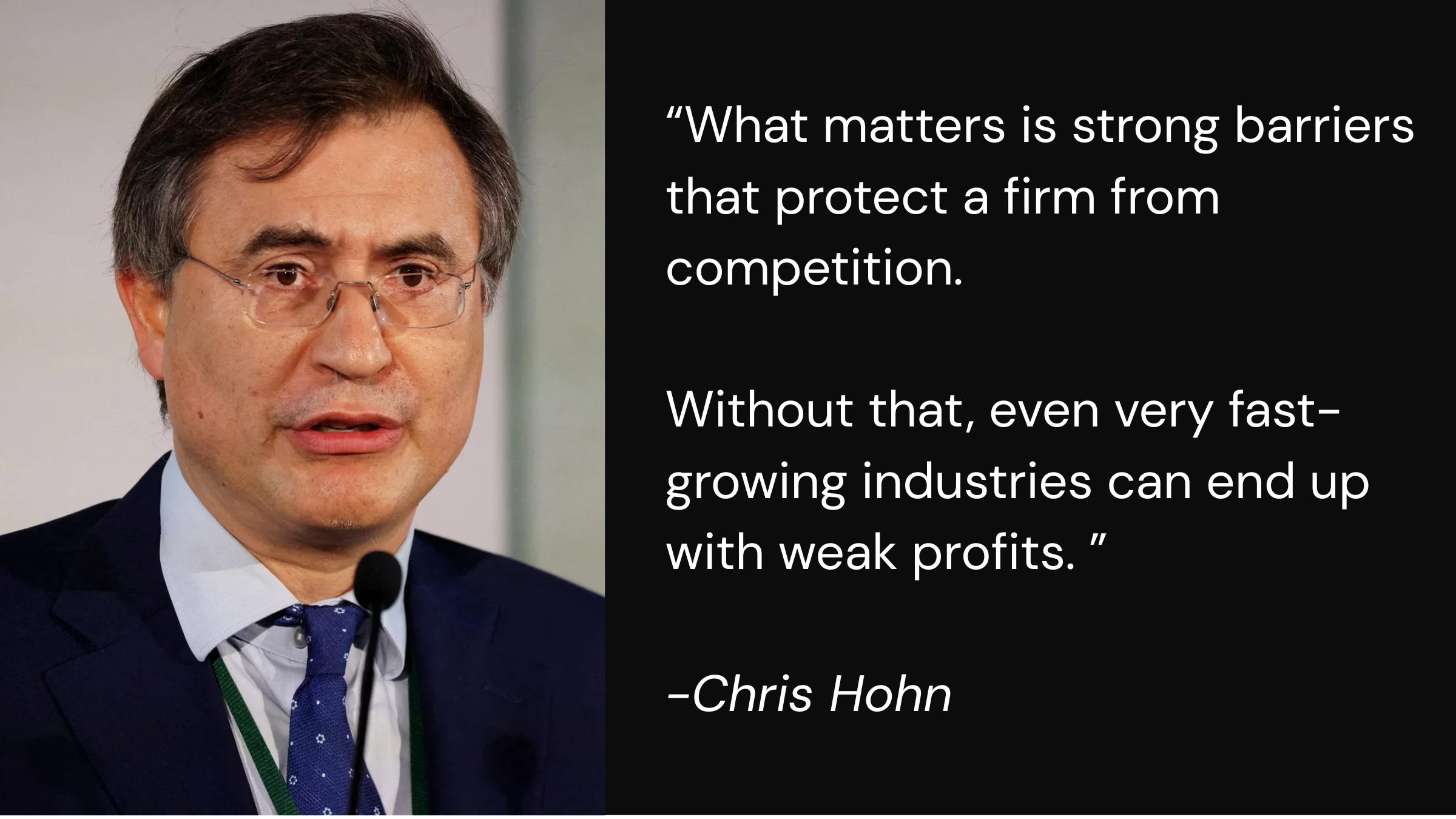
Competition covers two threats:
Competition from direct competitors
Competition from future alternative products/services, etc.
The first one is not a problem for Uber because of network effects.
Network effects simply mean that a product or service gains more value as more people use it. There are two types of network effects:
Direct network effects: An increase in usage makes the service more valuable for the same user segment, and propels growth in that segment.
Indirect network effects: An increase in usage of one group makes the platform more valuable for another user group, and propels their growth.
Uber benefits from substantial indirect network effects.
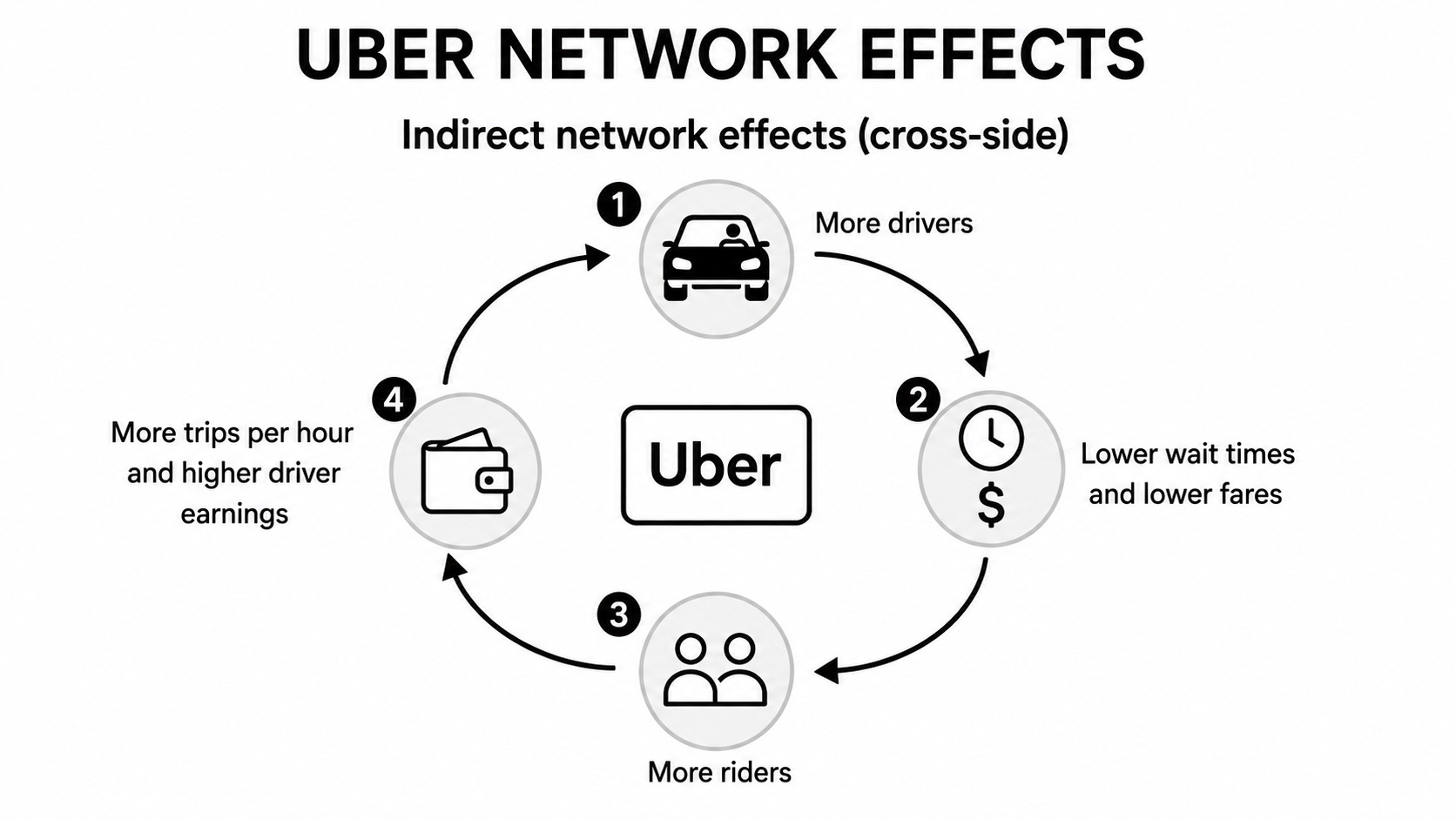
More drivers lead to lower wait times, higher prices, and better service due to competition, which leads to more customers, which leads to more drivers again.
This doesn’t just propel growth; it also locks in supply and demand. Drivers don’t switch because it means risking their current earnings. As a result, other platforms can’t accumulate enough supply to offer comparable coverage at lower prices. As a result, riders can’t find viable alternatives, so they don’t switch as well.
Thus, when networks reach a certain size where it’s more advantageous for every user group to join the incumbent rather than alternatives, they become almost impossible to disrupt. This network size is often called the tipping point or critical mass.
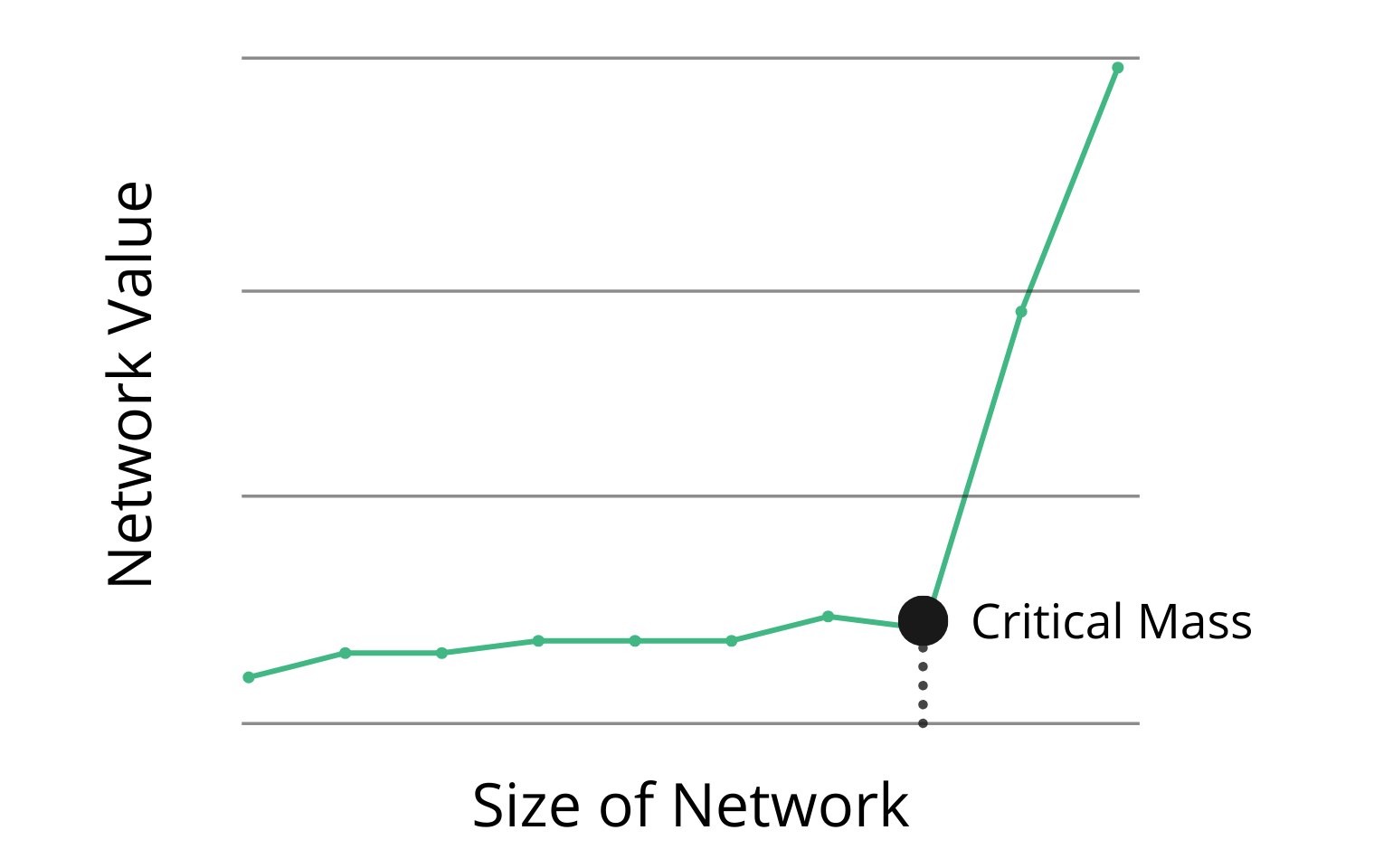
Since the beginning of the mobile era, which exploded the diffusion, no network business that reached the critical mass and domination has lost to a competitor.
Instagram, WhatsApp, TikTok, YouTube, Booking, Airbnb, etc. Indeed, it’s almost impossible to take on a dominant network business. Uber already proved this. Lyft was a formidable rival, but it couldn’t penetrate Uber’s network effects. Thus, Uber is very safe from this angle.
Thus, a more formidable threat for these businesses is competition from alternative products/services that emerge over time due to innovation.
SMS was also a great network, but it lost to online messaging because the latter is a superior product/service enabled by developing technology.
Here, the market is concerned about robotaxis effects on Uber’s business. I believe it’s unfounded for three reasons:
1️⃣ Generic demand always leads to aggregation.
If the demand is generic, incentives for aggregation exist regardless of the nature of the product. Think about spice and ride-hailing. They are two wildly different products, but the demand is generic for both. Thus, incentives for aggregation exist for both. On the one hand, this leads to grand spice bazaars, and on the other to Uber.
Even if we switch from human drivers to robotaxis, mobility demand is still generic. People won’t care whether they ride a Waymo or Tesla; they’ll just want to get from point A to point B at the lowest cost possible.
Generic demand leads to generic supply, which leads to a fragmented market.
Even if a firm holds substantial technological advantage initially, others eventually catch up. No exceptions throughout history.
So, what would happen if we had robo-taxis as a scaled, fragmented industry today? You would first see price comparison and referral sites like Skyscanner emerge, and then there would be aggregators. Over time, one aggregator would dominate.
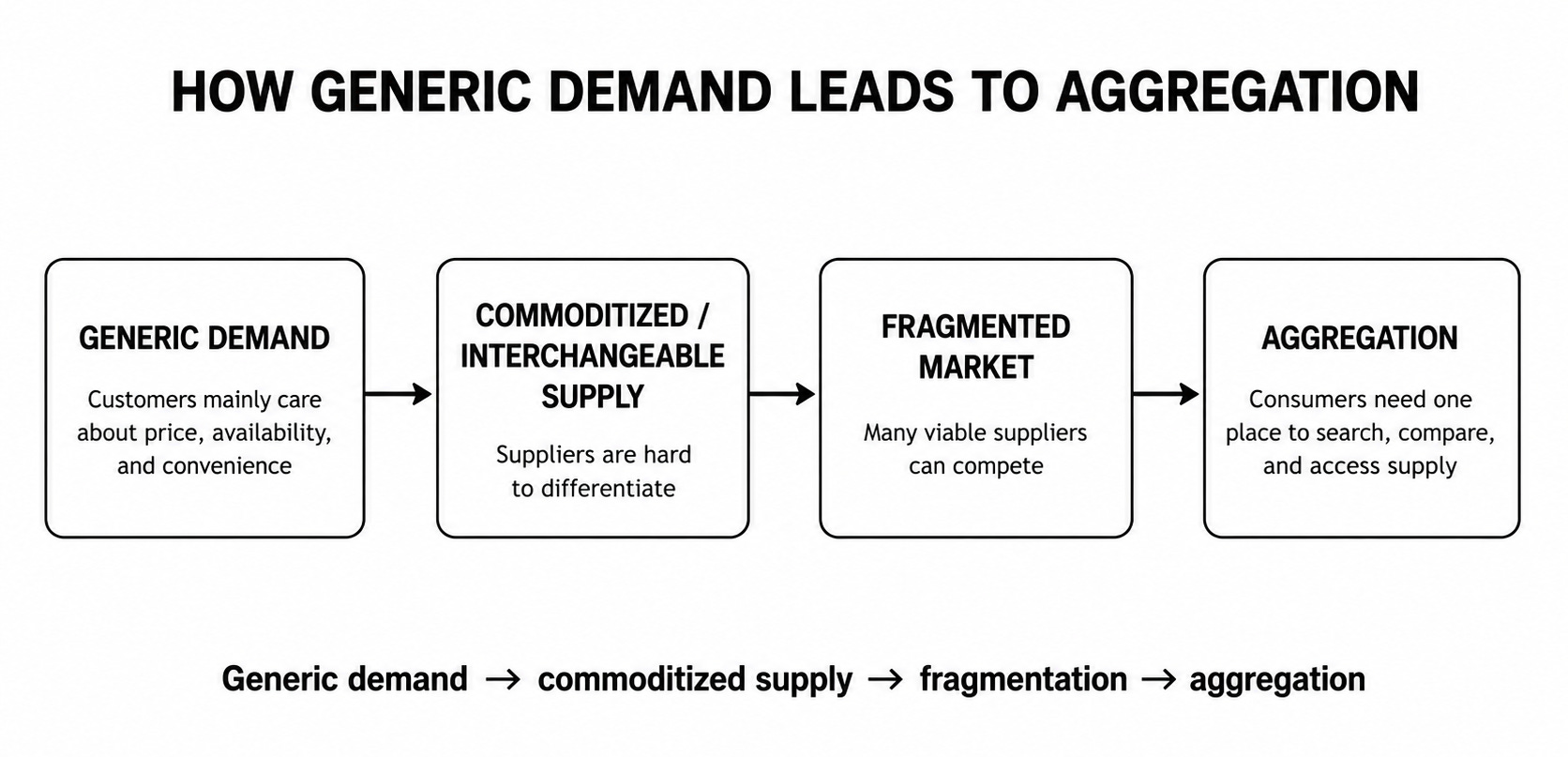
We already have that aggregator for generic supply today: Uber.
Current dominance doesn’t just position Uber as the best place to aggregate robo-taxi demand; it also provides substantial incentives for vertical integration, which is the second reason why it won’t be disrupted.
2️⃣ Aggregators have incentives for vertical integration.
This is why I criticized Ben Thompson above for positioning aggregation as an evolution of vertical integration in the digital era.
What actually happens is that aggregation incentivizes vertical integration when possible. We can see this in big-box retailers.
Companies like Costco are aggregators in a sense.
They aggregate several different brands of the same product in bulk, leading to selection and lower prices. This attracts customers, so they end up owning the customer relationship. Once you own the customer relationship, it makes economic sense to offer your version of the generic product.
They partner up with manufacturers to private label those products, which cost less than buying from another brand. Then they price it a bit below the competitors on the shelf, and still make way larger margins. Indeed, today private labelling is the most profitable activity for big box retailers as their economics mimic aggregators.
Thus, it makes economic sense for Uber to partner up with AV technology providers and offer Uber-labelled AV rides directly on its own platform. After all, it doesn’t make any difference for Uber whether it makes money on a human driver or an autonomous driver.
We are already seeing this as Uber has many AV partners:
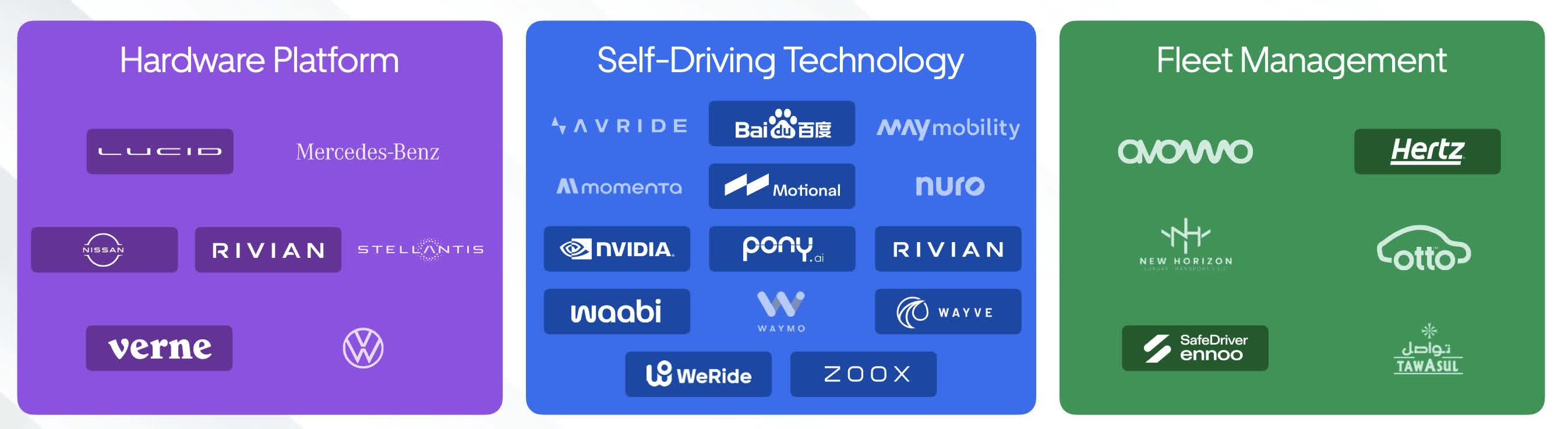
As you see, Uber doesn’t depend on a single partner at any stage.
There are reports about the winding down of the exclusive Waymo partnership in certain cities, but it’ll likely remain as a self-driving technology partner. Even if it doesn’t, there are a dozen other partners that completely depend on Uber.
Thus, as the dominant platform controlling the customer relationship, Uber can leverage these partnerships to offer AV rides directly on its platform. Due to its global scale, it can offer lower prices than standalone AV operators that are trying to scale through native deployments city by city.
So, such a vertical integration will bring substantial incremental margins to Uber and drown the competition at the same time, just like private label products in big box retailers do.
3️⃣ At scale, the economic model breaks for vertically integrated robotaxi makers.
Mobility is a business with substantial intra-day fluctuations in demand. It spikes early in the morning and in the evening, and declines during the day.
This doesn’t harm Uber because it doesn’t own the inventory. If it owned the inventory, it would have two options:
Keep the supply constrained, leave demand on the table.
Match the peak demand, leave fleet underutilized intra-day.
The first option would open up the ground for competition; the latter option would mean the inevitable demise of the business, as the fleet would either make a loss, or it would have to price too high, which would also open up the ground for competition, leading to a fragmented market and subpar margins.
This is exactly the case for AV fleet owners.
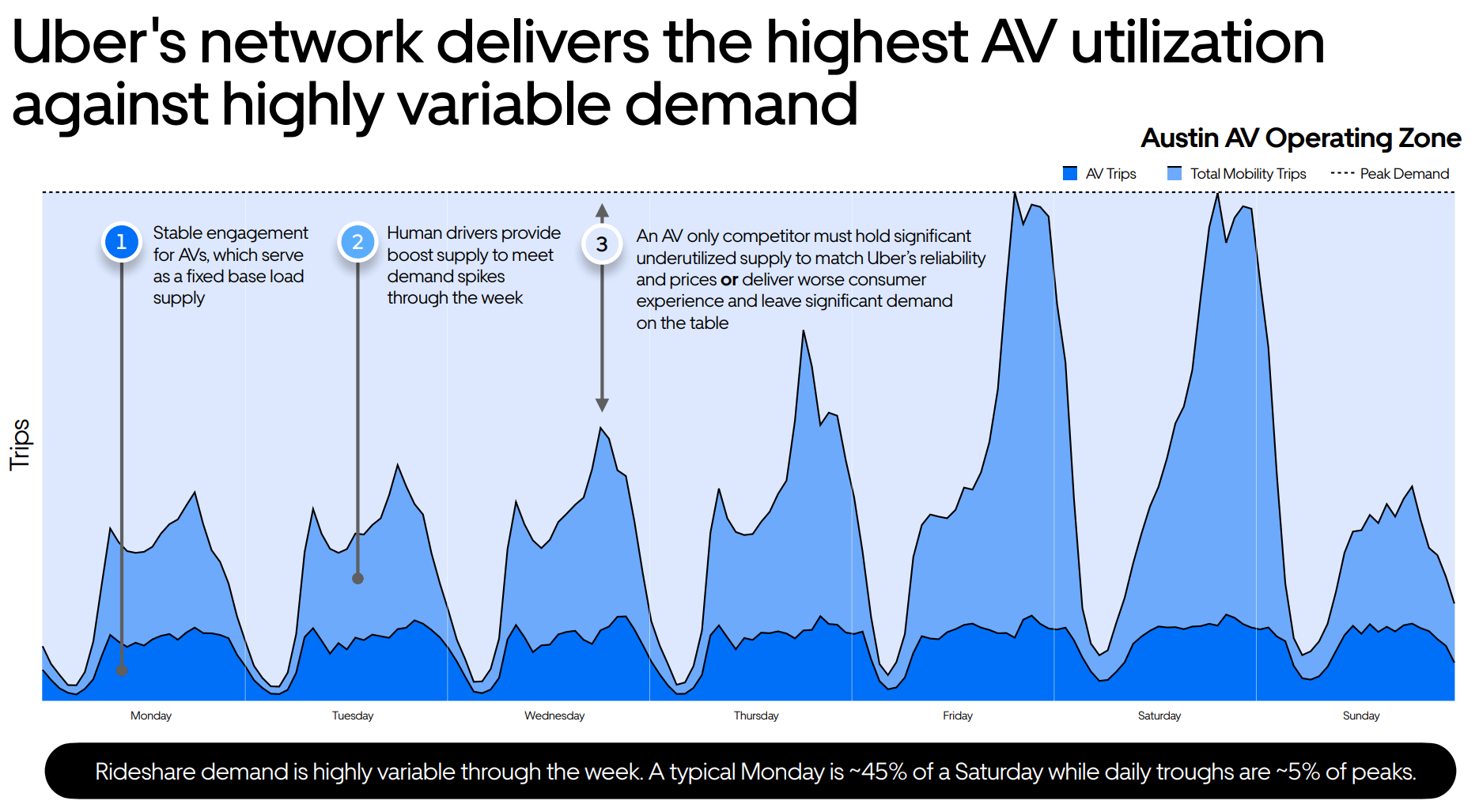
An AV holder that wants to compete with Uber needs to either hold a substantial underutilized supply, or leave demand at the table. This isn’t something vertically integrated AV owners can do, as each car comes with significant capex. Holding substantial undertilized AVs would plummet ROI.
Thus, it’s almost impossible for AVs to cannibalize Uber’s business at scale.
I even think that, in the long term, the AV model will evolve to be totally no-paid inventory, or there’ll be very little owned inventory. Most inventory will likely come from individual owners contributing their own vehicles to an aggregator when they aren’t utilized.
So, in short, Uber’s business is very strong, and I don’t think it’ll be disrupted any time soon.
Direct competition isn’t likely from here on due to network effects/critical mass.
Robotaxi is still a generic demand, which always leads to aggregation.
Uber can monetize AVs more efficiently through vertical integration.
AV economics break at scale, so they can’t eat Uber’s business.
So, Uber is going nowhere. To the exact opposite, it has substantial opportunities ahead for future growth.
📝 Investment Thesis
My Uber investment thesis is based on three key pillars.
1️⃣ Geographic expansion is back.
As we mentioned above, Uber was active in 72 countries at the beginning of the year. They have organically expanded it to 79 countries since then.
In July, it announced that it reached an agreement to acquire Delivery Hero, which has delivery businesses in 99 countries. Uber Eats is also a strong competitor in 14 of these markets, so DeliveryHero’s businesses in those markets will be acquired by a third party for compliance with competition laws.
This will give Uber a substantial presence in delivery in 85 other markets, where it’s somehow active but doesn’t have a strong delivery business. What’s more important is that Uber has no activity at all in 20 of these markets.
Thus, the acquisition will expand Uber’s active markets from 79 to 99 and increase cross-platform markets from 34 to 58:
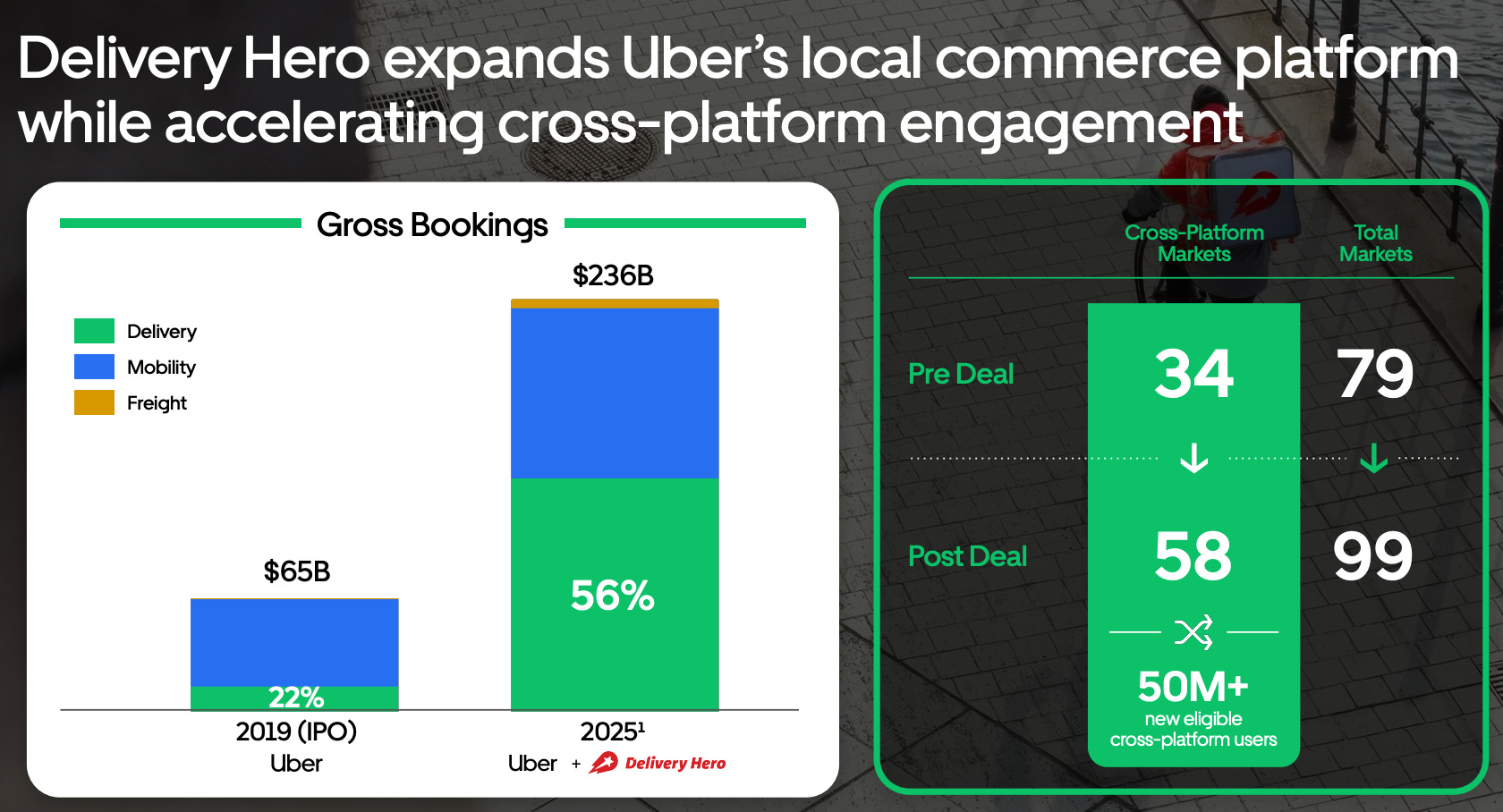
This means substantial geographic TAM expansion and opportunities to cross-sell. For reference, 30% of the customers in Uber’s cross-platform markets use both delivery and mobility.
These new cross-platform markets currently come with 0% cross-platform customers. We can assume this will grow to the average of other markets, 30%, driving substantial top-line growth over the next few years.
Note that most of the markets that’ll come with the Delivery Hero acquisition are in Asia and the Middle East, which are way faster-growing markets than Uber’s core markets in the West. Thus, cross-platform scaling in these geographies will likely lead to a way bigger TAM for Uber than we can see today.
2️⃣ Delivery has a long runway for growth.
When Uber first started, delivery was just 22% of its gross bookings; today it’s 56%.
The delivery business doesn’t face the regulatory headwinds the mobility business faces. In many countries, mobility is a regulated sector requiring licenses, membership to guilds, etc. Thus, Uber’s mobility business has been struggling to expand geographically.
Delivery, however, isn’t regulated, so most markets are up for grabs. Plus, delivery frequency per customer is higher than mobility. Thus, delivery has grown very fast:
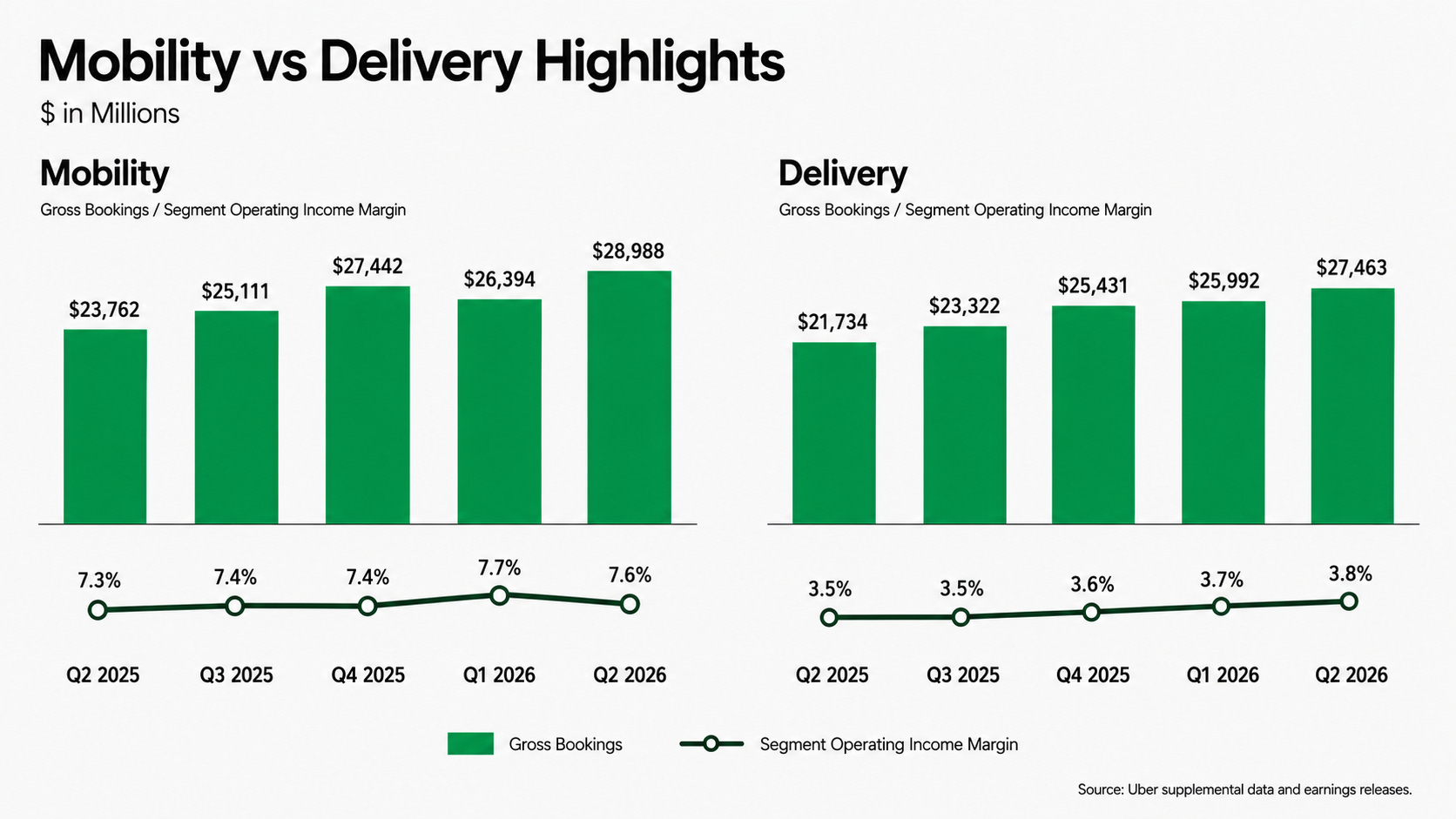
The global delivery market is projected to grow 10% annually over the next decade, so fast growth in this segment can sustain for at least another decade. Plus, margins in this segment are currently half of mobility. Over time, margins in this segment will likely catch up and even exceed mobility, driving even faster bottom line growth.
3️⃣ AV adoption at scale will lead to margin expansion.
Uber’s take rate in its mobility segment is around 25%.
The large drop from Q4 2025 to Q1 2026 was largely due to accounting changes in the UK. Uber started to record driver payments out of London as contra-revenue rather than cost of revenue for tax purposes, which led to a cosmetic 400 bps drop in take rates:
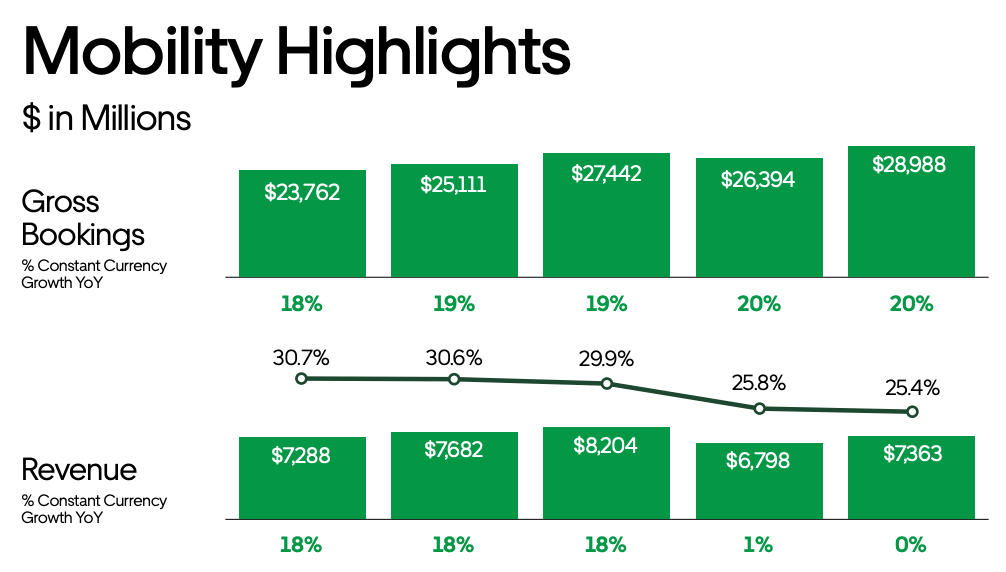
So, even if you follow the old accounting, Uber’s take rate is around 29-30%.
Goldman Sachs estimates that gross margins on an AV robotaxi fleet will be no less than 30% and could be as high as 50%. This means that Uber’s current take rate is the bottom line of what it would earn on an AV fleet.
Thus, even if we take the mid-point of Goldman’s estimate, 40%, Uber can see a substantial expansion in mobility margins if it scales its AV fleet.
Plus, AVs have way lower crash frequency compared to human drivers:
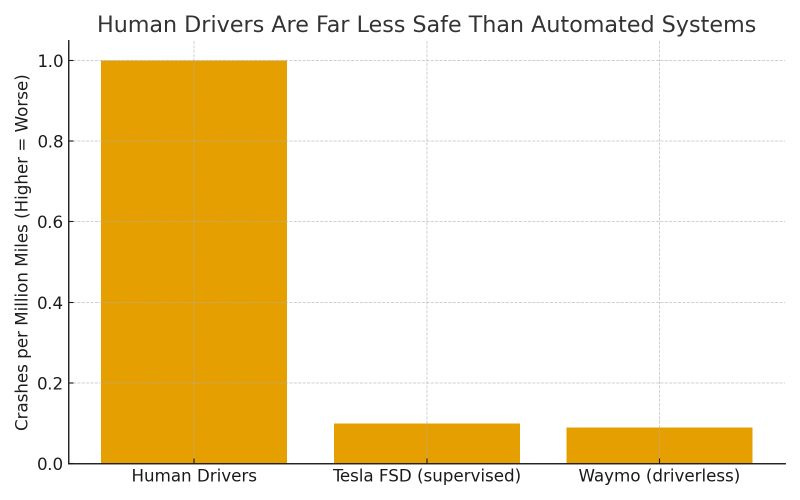
This is going to get even better as autonomous systems develop. This is projected to drop insurance premiums for AVs up to 40% compared to human-driven cars, further expanding margins for Uber.
In short, Uber has many tailwinds going forward:
Geographic expansion is back.
Delivery has secular tailwinds.
Autonomy will lead to higher margins.
It doesn’t have a shortage of opportunities, so what’ll determine performance will be execution, and it’s been superb so far.
📊 Fundamental Analysis
➡️ Business Performance
Uber’s performance has been solid since the business normalized in 2022 after Covid 19. It’s grown revenues 14.7% annually while net income has also inflected.
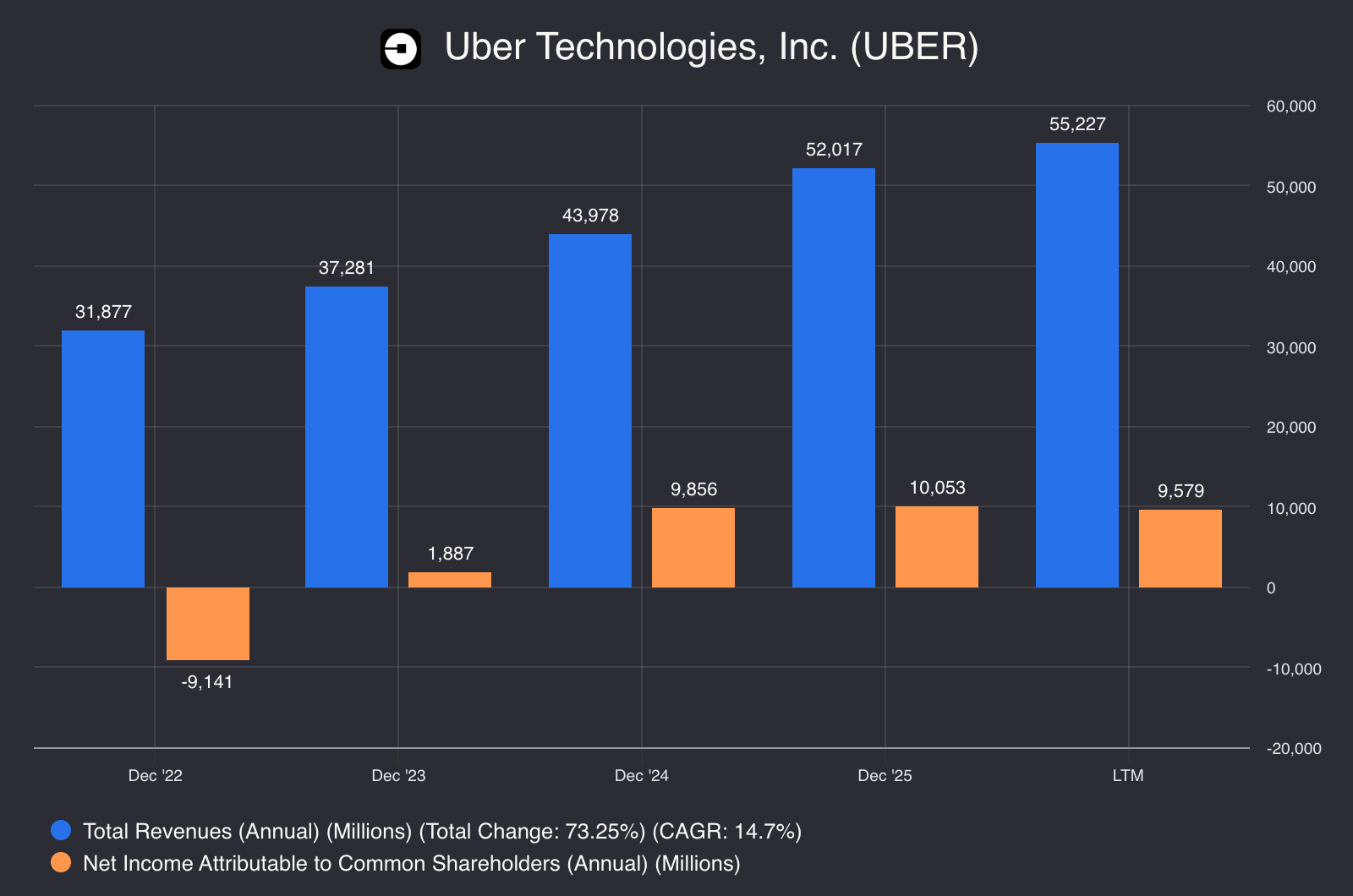
This is despite the artificially understated growth over the last 12 months due to accounting changes in its UK business.
Before these changes, driver payments were recorded under cost of revenue; now they are labelled as contra-revenue for tax purposes. This puts a drag on the headline revenue growth, and makes take rates artificially lower.
Thus, it looks like revenue growth has halted. This is not the case, as you see; growth in gross bookings has accelerated over the last two quarters, let alone decelerating.
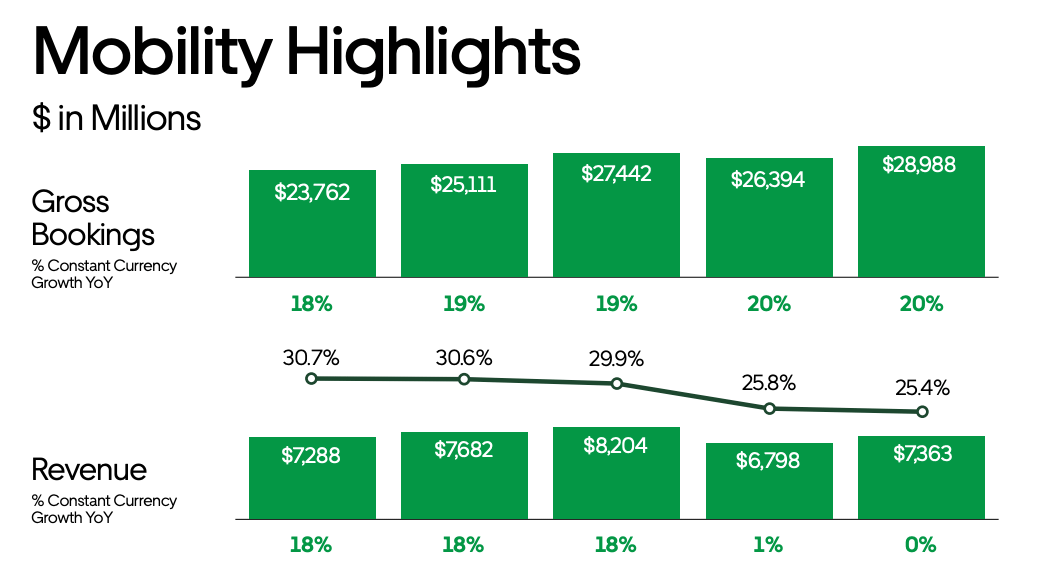
If the old accounting rule had been sustained, annual revenue growth since 2022 would have been 16% instead of 14.7%. Meaning the business is even stronger than it looks on the surface.
We are looking at a dominant network business/agregator growing above 15% annually like clockwork. I don’t think any serious investor would sniff at this.
➡️ Balance Sheet
Its balance sheet is rock solid.
It currently has $28.4 billion in equity against just $14.7 billion of debt and $7.4 billion of EBITDA.
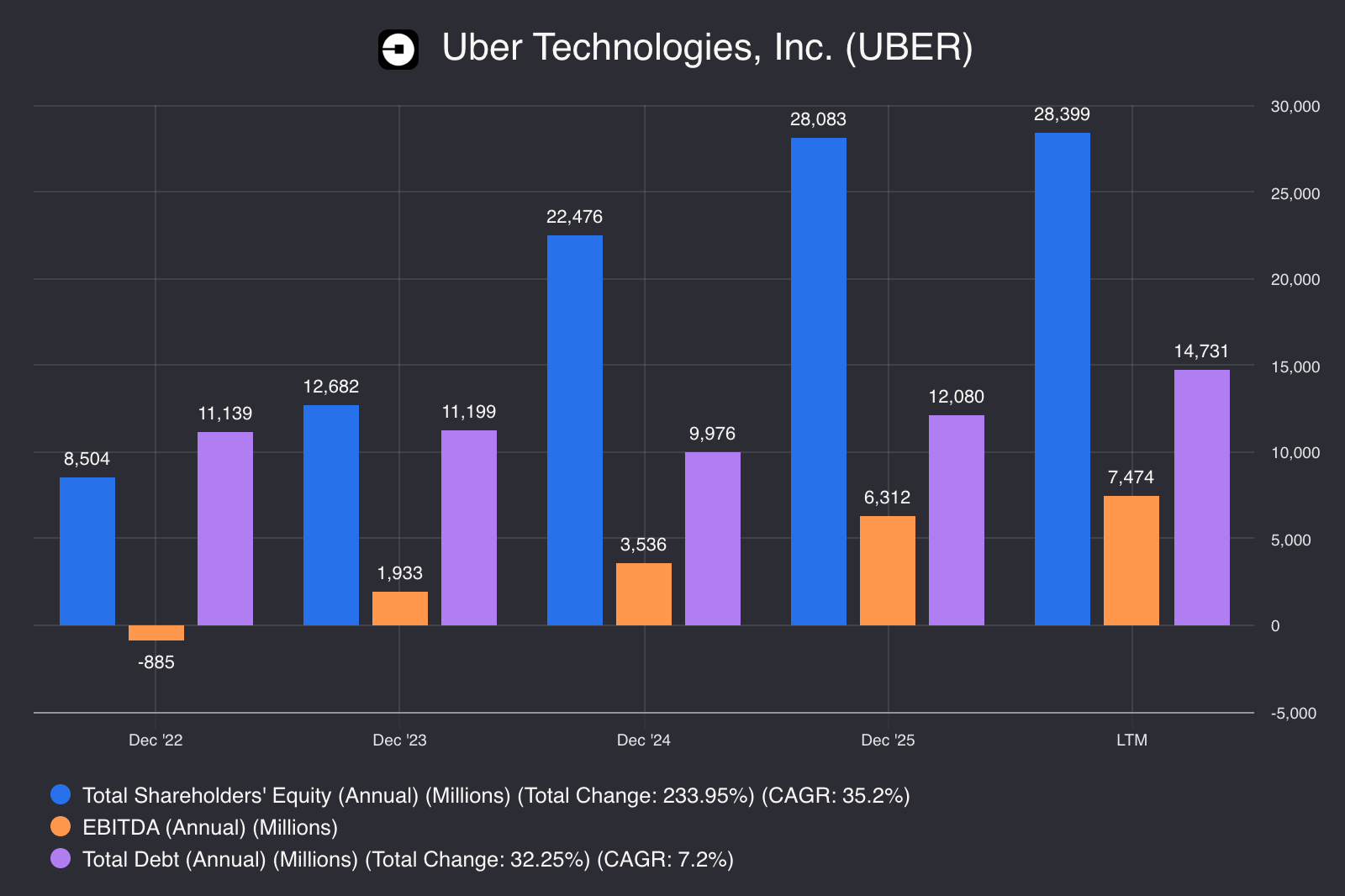
This means its Debt/Equity ratio stands at just 0.5x, while its annual EBITDA can cover the whole debt in under two years. There is not much nuance here; we are simply looking at a business on very strong foundations.
It can weather any financial storm with ease. No red flags here.
➡️ Capital Efficiency & Profitability
⏺️ Gross & Operating Margins
Margins clearly validate the fundamental assumptions regarding a network business like Uber: Dominance and operating leverage.
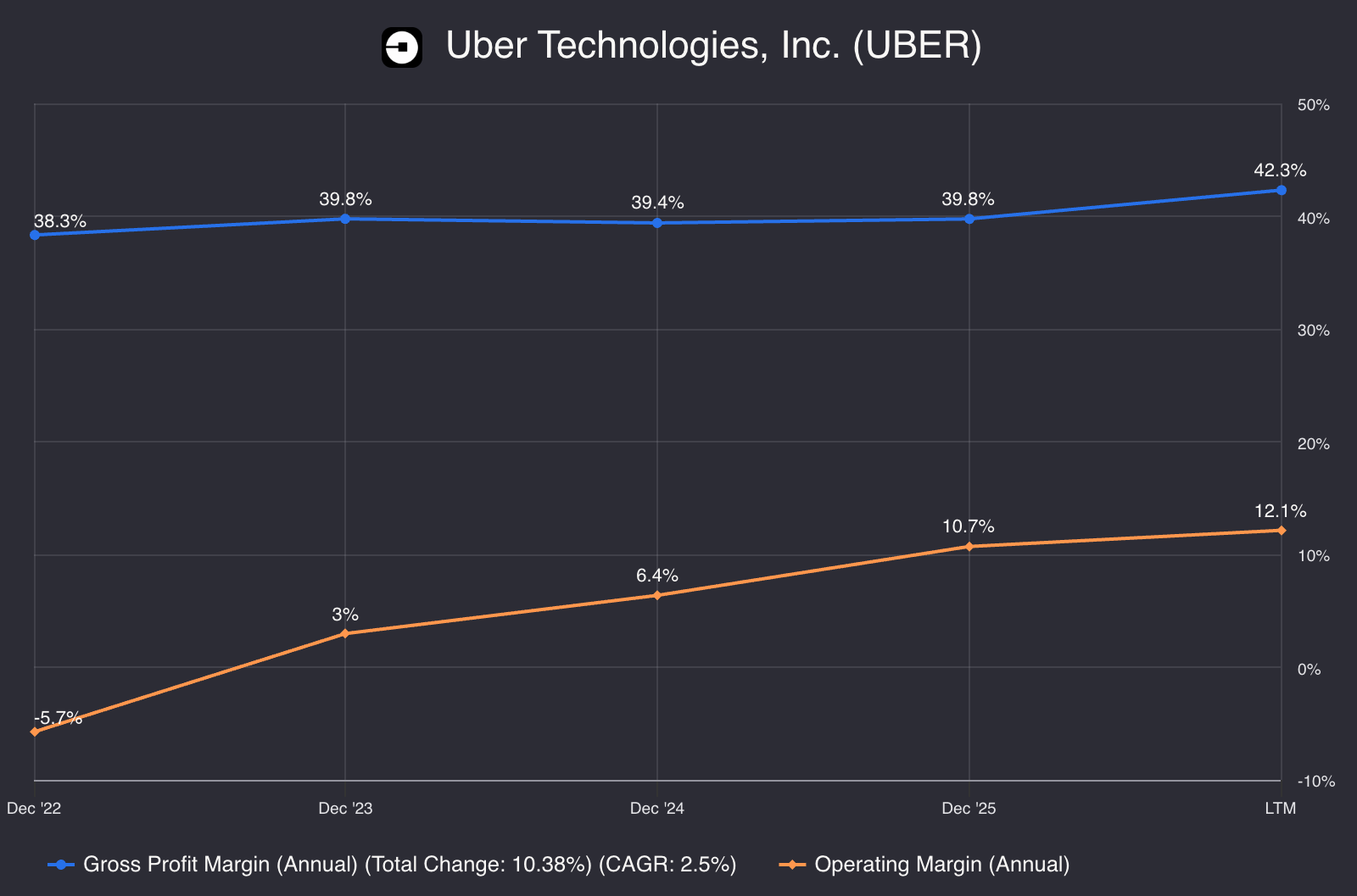
As you see, gross margin has expanded by almost 5% since 2022, meaning it doesn’t feel any pricing pressure. This is exactly what we would expect to see from a dominant aggregator.
In the same vein, operating margin is also on a steep way forward, meaning the platform has reached a level where the business can cover high fixed costs, and every incremental dollar of revenue leaves higher margins as operating expenses associated with serving an additional customer are near $0.
From now on, we’ll see every dollar of incremental growth contribute positively to operating margins.
⏺️ Return on Invested Capital (ROIC)
Uber’s ROIC is also comfortably above satisfactory levels.
For reference, the average ROIC of all American firms is around 12%. Uber’s median ROIC since earnings inflection is about 18%.
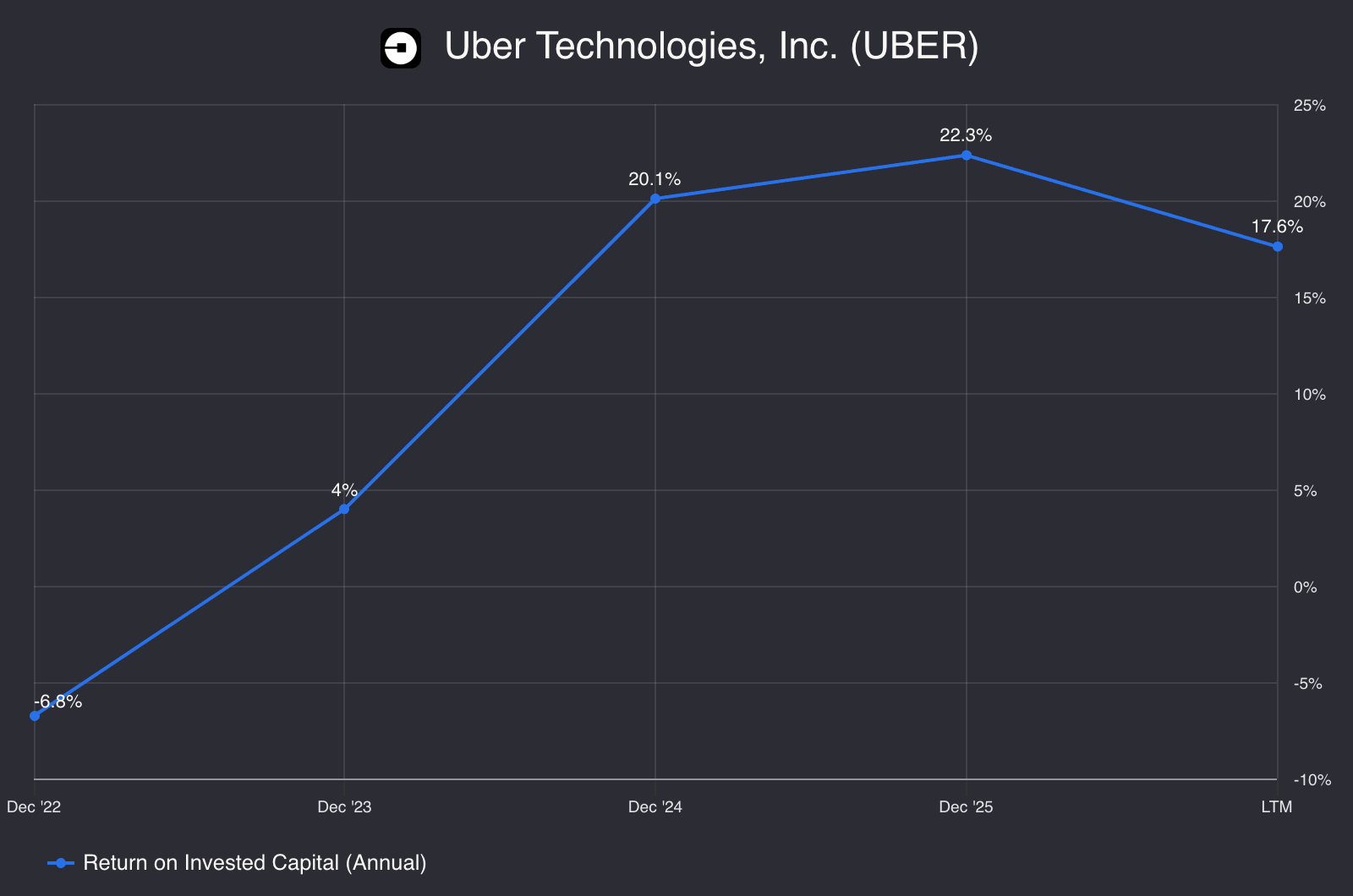
This is, of course, a back-looking metric, but it tells about Uber’s track record in capital deployment. If Uber can deploy incremental capital and generate returns anywhere near these levels, shareholders will be more than happy going forward.
To sum up, Uber’s fundamentals are rock solid.
We are looking at a business with persistent double-digit growth, a strong balance sheet, expanding margins, and high return on invested capital with several substantial growth opportunities ahead.
In a setup like this, the decision turns to valuation as the rest of the business screams excellence. So, let’s look at the valuation.
📈 Valuation
When we have a durable business, valuation is just coming up with conservative scenarios with high likelihood to materialize and running the numbers.
We have already established the durability part for Uber. So, what would be a conservative scenario for Uber?
It has growth opportunities, and I think anybody could price higher growth from here. However, to be conservative, I will assume that growth opportunities will only help it sustain the current growth rate for a longer period. So, I’ll assume 15% annual growth for the next 5 years, which then converges to 3% in year 10.
When it comes to operating margins, more mature aggregators like Booking operate with around 30%. Even Airbnb currently has over a 20% operating margin, and it’s expanding. So, I believe it’s not unreasonable to assume 25% operating margins for Uber in maturity.
Some sources estimate its cost of capital at 8%, and some sources at 12%. I take the midpoint and use 10% as the initial cost of capital and assume it’ll converge to 8% over time, which is still 0.5% higher than the average cost of capital of mature businesses.
When it comes to ROIC, I believe it’ll be able to sustain 15% ROIC in the terminal period thanks to its dominant position. To be conservative, I assume a 25% tax rate.
Here is what these numbers give us:
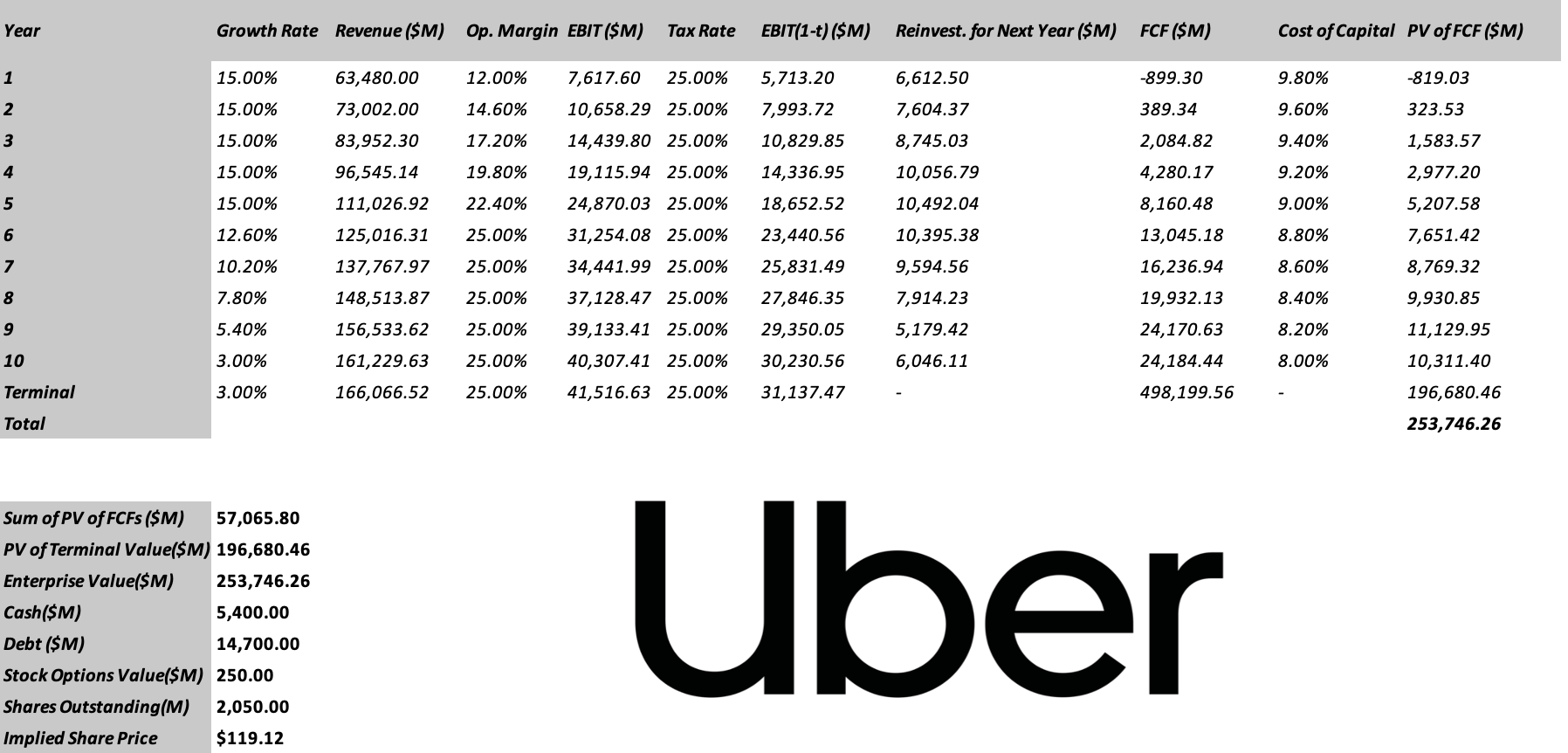
This means that the current market price implies a 37% discount to our intrinsic value estimate based on conservative assumptions.
To be fair, the most important lever here is probably the duration of faster growth. I believe it’ll take way longer than 10 years for its growth to converge to 3%, given the growth opportunities ahead. Even a slightly higher starting figure for terminal period compounding will make a substantial difference in intrinsic value.
Plus, it can do better than a 25% operating margin. A more realistic figure would be around 30%.
So, we can say that the market discounts Uber by at least 37% and probably more. This is enough margin of safety already that could cover many future mistakes.
I think this is a pretty attractive offer by Mr. Market.
🏁 Conclusion
Exceptional businesses rarely trade at a discount. When they do, it’s more often due to concerns about the future of the business. Sometimes it’s valid, sometimes it’s not.
Thus, if you can spot a situation where the market discounts an exceptional on what’s actually unfounded concerns, you can make a lot of money betting on it.
This is what happened with Meta in 2022, Google in 2025, and Microsoft earlier this year. Now I believe it’s happening with Uber.
People are disregarding the incentives for aggregation in generic supply/demand and then aggregators’ incentive to vertically integrate to expand margins. When we think about these, we can easily see that autonomy could be a tailwind for Uber, rather than a threat.
Plus, massively variable demand within the day mandates that robotaxi businesses hold a massive underutilized fleet to monopolize the market, which doesn’t make economic sense as underutilized vehicles could take longer to earn their capex than their replacement cycle, leading to negative ROI.
Thus, I believe fears of disruption are not founded.
Uber is very well positioned to benefit from autonomy in the form of higher per-trip margins and lower insurance costs.
Given that further geographic expansion is underway and delivery has secular tailwinds, I think we are looking for a business that will grow at a double-digit annual rate for the next 4-5 years.
Valuation is also attractive on conservative assumptions.
Given all these, I think Uber is a pretty attractive opportunity now, and I am thinking about making a place for it in my portfolio.