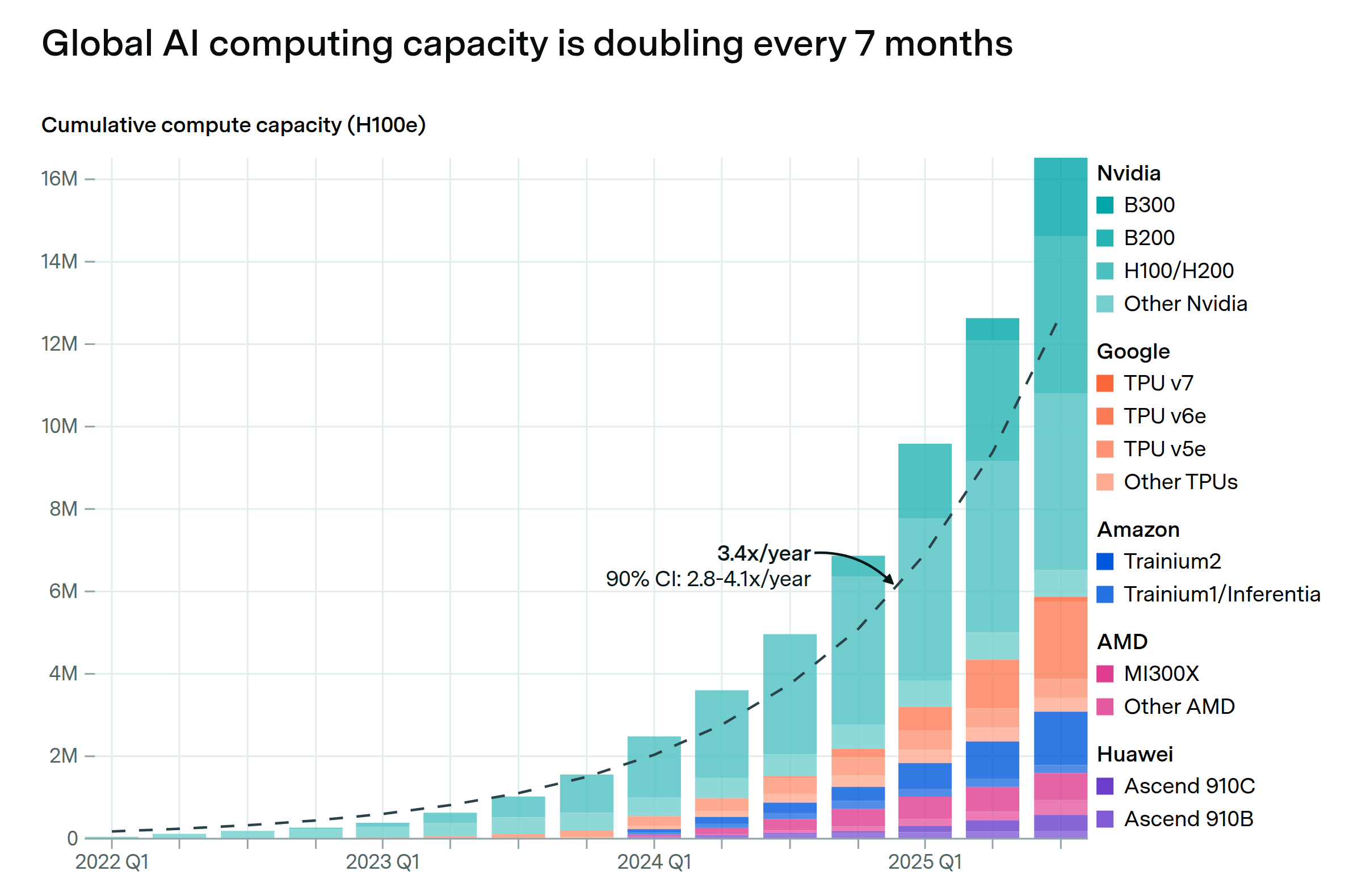
More Compute, Please.
Even the most optimistic estimates underplayed the compute we need.
“As fast as we put the capacity in, it's being consumed.” — Andy Jassy, Amazon CEO, said this in Amazon’s Q1 earnings call last year.
Almost a year later, after he said the words above, we read in his annual letter earlier this week that:
Tarinium 2 capacity was sold out.
Trainium 3 is almost fully subscribed.
A part of Trainium 4 is already reserved.
Not just the capacity they have connected, but also the capacity they are planning to connect is being bought out.
It’s not that different for other could players as well. Nebius missed the consensus revenue estimate last quarter because it ran out of capacity to sell. Satya Nadella said Azure will double its capacity over the next 2 years, and Sundar Pichai said in a podcast that they could spend even $400 billion in capex if hardware supply weren’t constrained.
They know they could sell the capacity as much as they put it out. When you turn to buyers, you see pretty much the same lingo. OpenAI’s CFO, Sarah Friar, recently said: “I do spend a lot of time trying to find any last-minute compute available here in 2026.”
Normally, I would be very skeptical of this much alignment in an industry and think that it should be hype-craft. It’s not, that’s the reality on the field.
Last week, we got one perplexing data—Anthropic ARR increased from $9 billion in early January to $30 billion at the end of March. It basically tripled in just 8 weeks.
Anthropic’s increased API outages following the release of Claude 4.5 show how exponential the demand was.
The demand was so excessive that Anthropic had to reduce the default thinking level of the model to be able to serve everybody and solve frequent shortages. This is what caused the retardation of Claude that we felt over the last few weeks; it was dictated by a structural shortage that couldn’t be solved quickly.
The lenses we see AI through suggest that this is just the beginning. We are in the early innings of a demand shock that General Purpose Technologies experience when they reach minimum viable capabilities. This stage determines the direction and scale of the medium-term infrastructure buildout, shapes business strategies, and picks winners from losers.
We’ll explore what this means, where it leads us, and what the implications are for investors.
This Is Just The Tip Of The Iceberg
The coming demand is so insane that what we see today is nothing compared to it, maybe not even the tip of the iceberg.
The economic concept I have been using to make sense of AI and where it’s heading is General Purpose Technologies (GPT—funny coincidence, it’s not the same GPT as in ChatGPT). The concept basically suggests that there are a handful of technologies that are inputs to an extraordinarily large number of other innovations.
Think about the fridge and chips.
Fridges, regardless of how transformative they are in human life, don’t contribute many other innovations. Chips, on the other hand, are the backbone of the modern world. The vast majority of all electronic products have chips, and they power many digital technologies like the internet, software, etc.
As a result, the long-term demand curve of GPTs looks way different than other technologies. While other technologies flatline in demand, GPTs keep rising since their use cases expand as they develop, spurring innovations and developments in the existing ones.
Again, if we follow the microchip example, we see that as chips themselves developed, other technologies that use them, like computers, also developed, and new versions of the computers required even more chips. This development also enabled new use cases, like mobile phones, further increasing the demand.
Our thinking is that AI is one of those general-purpose technologies that will infiltrate many products we are using today and spur the development of new ones.
Thus, the demand for AI will increase secularly over the long term. AI itself will also develop, enabling new use cases and new products, which in turn increase demand again. A self-perpetuating demand cycle, just as we see in electricity, chips, and the internet.
This is intuitive, as we can easily imagine that most of the electronic devices we are using today will integrate AI. Computers, mobile phones, cars, home systems, etc. This is where it will eventually go.
Each new generation of GPTs comes with enhanced capabilities that spur investment in complementary innovations, increasing the demand for a GPT. Not each generation is equally powerful in unlocking new use cases, innovations, and thus demand.
There is a point where a GPT reaches a set of capabilities that makes deployment into many areas and products feasible. I call this “minimum viable capabilities.” When a GPT reaches its minimum viable capabilities, it’s deployed beyond the early use cases that were natural and easy fits, i.e., the transformative power of a GPT hits at scale.
This is where demand explodes.
Think about chips.
Jack Kilby created the first working integrated circuit in 1958, which was roughly the size of a paper clip. It contained just a single transistor.
The first commercial device based on this concept, the Type 502 Binary Flip-Flop, was introduced in March 1960 and priced at $450 each, about $4,800 in today’s money for a single chip that did almost nothing by modern standards. It was a narrow application that was a natural fit for the narrow capabilities of the first version of a GPT.
Early applications remained very limited and were focused on the cost-tolerant industries like aerospace and military. Chips reached their minimum viable capabilities for mass deployment somewhere between 1971 and 1975, as Intel developed its commercial microprocessors.
The first one was the Intel 4040, released in 1971. It was a 4-bit processor that could only run from ROM and was intended for a single-purpose use by a Japanese calculator company. Intel 8080, launched in 1974, was probably the main “minimum viable capabilities” moment, as it was small, cheap, and programmable enough to be embedded in everything.
Total semiconductor sales jumped from $2 billion in 1970 to $10 billion in 1979 as chips were now going into everything.
Look at all transformational GPTs, and you’ll see a similar pattern. Steam engines spread after the invention of the Corliss Steam Engine, which allowed automatic control of steam admission under varying loads; the electrification took off after Tesla discovered the A/C transmission; the modern internet emerged in 1983, but it took off after Tim Berners Lee introduced the World Wide Web, etc.
All those milestones expanded the capability set of those GPTs to a degree that large-scale adoption and following productivity growth were made possible.
We are at a similar “minimum viable capabilities reached” moment for AI models.
Early versions of the models we are using today were impressive compared to chatbots before, but they were actually useless in creating something of economic value.
They worked best when they were asked a question already in the dataset, but were pretty useless for real creation. They hallucinated a lot, and even the code written by them was largely broken.
This is no longer the case.
The tool use has improved so much that even a standard model today can use several tools from search to code execution, which enables them with tasks that require going above and beyond their training set. The core capabilities have also developed substantially as we focused on things that AI can do very well, like coding.
As a result, models today can execute complex tasks agentically, performing hours of complex work like coding at an elite level. Thus, we have moved from having those who could be considered as “assistants” at best to having “virtual employees.”
Most people don’t understand how much of a demand this unlocks. It’s not just skyrocketing software new creation and deployment, it’s also forcing firms to rewrite all the software.
The vast majority of our software installed base was created by humans over the last 30-40 years. They are filled with security weaknesses, bugs, etc. If these weaknesses aren’t patched, new models will become a pure cybersecurity threat as they’ll be able to easily break most of the software we have now.
Coding is just the most obvious example. A whole ecosystem of tools and connectors has now been developed, allowing AI models to use applications autonomously. It’s not just basic software like Excel, Word, and PowerPoint; they are using complex apps like Figma, Adobe, etc., and they can come up with satisfactory work.
Marketing another area that is being quietly transformed. Most talking head UGC videos you see today on Instagram ads are created by AI, static ads are 90% AI generated, so are the copies of all those ads.
We have reached the minimum viable capability set, and the demand is exploding. The fact that Anthropic’s revenue tripled after the release of Opus 4.5 in late 2025 illustrates this:
This level of demand clearly exceeds Frontier Labs’ projections as Anthropic had to dumb down Claude and OpenAI had to discontinue Sora to repurpose the compute into higher demand areas, like Coding. They can’t serve everybody, and even those they can serve don’t get the full potential. It’s just insane.
This is just the beginning, as we are just at the first or second generation of models that could be considered to have minimum viable capabilities. When we get the next generation models, deployment will again accelerate as new capabilities will be put into productive use.
The demand shock we are experiencing has one substantial consequence for the frontier AI labs, and thus the whole ecosystem: Those who secure the compute will take market share.
Thrive Or Die By Compute
All general-purpose technologies are doomed to be commoditized. This is the nature of the concept. Such a large-scale diffusion can only happen with commoditization.
Electric is a commodity, the internet is a commodity, most of the chips are commodities, etc. Look at all that could be considered a GPT, and you’ll see that it’s a commodity.
The natural result of this is that when one provider is supply-constrained, the demand easily shifts to another. This is exactly what we are seeing now. Anthropic has overgrown OpenAI thanks to its narrow focus on coding and enterprise use. The demand exceeded their ability to serve while running the models at full potential. They dumbed down the models to serve everybody. People felt it and started to switch to OpenAI’s Codex from Anthropic’s Claude Code.
This will always be the case until full commoditization, where the market forces will force every supplier to offer similar performance and usage at more or less the same price. Thus, the provider that has more compute has a significant advantage at this stage.
It’s not just in terms of the ability to serve customers and capture market share. Development of new products, thus capturing new demand, is also limited by the computing power you have.
Take a look at this leak:
Anthropic is developing a Lovable-like vibe-coding feature. That’s the most natural thing in the world, as Lovable also runs Claude under the hood. They’ll come for all those AI software that are basically wrappers of their foundational models. The only thing that limits them is compute.
So, securing more compute is a strategic priority for all frontier labs now. They will live or die by their ability to secure compute. The one that can secure more compute can distribute its frontier model more widely and bring new products to market faster, accelerating its revenue growth, which enables it to access more compute.
Those who fall so much behind will lose their ability to catch up unless we see decisive flattening in model performance soon. They won’t be able to sell models as they’ll be way behind the SOTA, so they won’t get more compute to improve, and this cycle will eventually lead to their downfall.
So, basically we are looking at the following picture:
The capabilities have hit a milestone that enables deployment at scale and scope.
Demand is already skyrocketing, and we are seeing just the tip of the iceberg.
If you are an AI lab, the strategic implication of this is that you should buy every bit of compute you can find. You know you’ll sell, the demand is there, and you are only limited by your ability to serve. At this stage, underestimation of the compute you need is costlier than overestimation.
While their demand trajectory looks vertical, the compute supply is drying up. Half of the data center projects planned for this year will be cancelled or delayed as electrification won’t be possible due to the bottlenecks in electric equipment supply.
Meaning? If you have already secured the site, power, and construction is on time, you are golden. You’ll be able to sell faster than you bring the capacity online. This is the most important implication for us, investors.
AI Infrastructure Trade Is Now Derisked
This is the most important consequence for investors.
Up until recently, we have been skeptical of near-term overbuilding as all hyperscalers have been pressing hard to expand their capacity, and most Bitcoin miners have pivoted to capitalize on the opportunity. Oracle is a striking example because it has transformed itself from a software company to a hyperscaler and put itself under a lot of debt to pull it off.
So, the faith of these investments was effectively tied to how much demand frontier models would generate. Oracle currently has around $553 billion of cloud backlog, and OpenAI is responsible for over $300 billion of it:
As a result, CDS on Oracle debt spiked and reached record highs, sending the stock down by 50% from its highs. This is why it’s currently trading at just 15x 2028 earnings, making it the cheapest hyperscaler in the market.
Earlier this year, Oracle CEOs said OpenAI wasn’t as big a risk as the market thought because they would be able to sell to other players. That didn’t satisfy the market because we were still suspicious of the broader demand as well.
It’s no longer the case as I explained above.
The technology has hit an inflection point, and we are just in the early innings of the deployment at scale and scope. Demand is skyrocketing, and AI labs’ ability to generate revenue is only limited by the amount of compute they have.
Thus, AI labs will race to secure more capacity. As they turn capacity into revenue, their ability to raise money also enhances, which further derisks investments like Oracle.
They still have to show the execution at the unit economics level, but that’s a more manageable risk profile than the one that is tied to external demand factors. However, the market is yet to acknowledge this, and many of those compute plays are still trading at a significant discount to their potential, most notably Oracle.
Thus, I think the infrastructure plays, Oracle in particular since it already has the commitments, are attractive and investable. I don’t know when, but I know it’s a matter of time because the market recognizes this enhanced risk profile and bumps up those stocks.
Closing
I see the AI through the lens of GPT literature.
Every GPT hits a critical capability milestone that accelerates its diffusion, and thus skyrockets the demand. I think we have been waiting for this moment for AI since ChatGPT was launched in 2022.
We didn’t know whether AI would ever get there, fulfill its promise, and become a transformative GPT. That also created skepticism for the demand and investments that relied on the assumption of skyrocketing demand.
With the latest generation of models, we reached that milestone.
Models can now be deployed in many tasks and create real economic value at scale, which was something they were incapable of before, probably by late 2025. Buyers feel that, and the demand is skyrocketing. This is just the beginning. We have just got there, we’ll see an insane amount of demand ahead as AI is deployed at scale and scope. AI labs’ ability to serve this demand is limited by their computing capacity, which is getting scarcer due to bottlenecks in the supply chain.
As a result, it’s a strategic imperative for them to buy and reserve every bit of compute they could find. If they can’t serve, demand will shift to competitors that have the compute capacity and thus can serve.
This derisks compute plays that invested a lot in building infrastructure, like Oracle. The market still keeps this discount as it’s always slower in acknowledging qualitative changes in the environment. I don’t know how long it will take, but at some point, the market will recognize this and bump these stocks up.
We are just seeing the early signs of demand shock that is coming and we’ll need a helluva lot more compute. I am sure of this.
That’s all friends!
Thanks for reading Capitalist-Letters!
Please share your thoughts in the comments below.
👋🏽👋🏽See you in the next issue!


Crazy to me how fast this AI technology is advancing. I'm still struggling just to understand crypro, NFT's, etc... Man this world of technology is advacing so fast!