Magnum: Special Situation With 50% Upside Potential
Spin-offs with wide moats are rare. Magnum is one of them and it's trading at a deep discount to peers.
The first rule of winning games is to play a game in which you have a competitive advantage. The playing field should be tilted in your favor.
The legendary CEO of General Electric, Jack Welch, puts this eloquently:
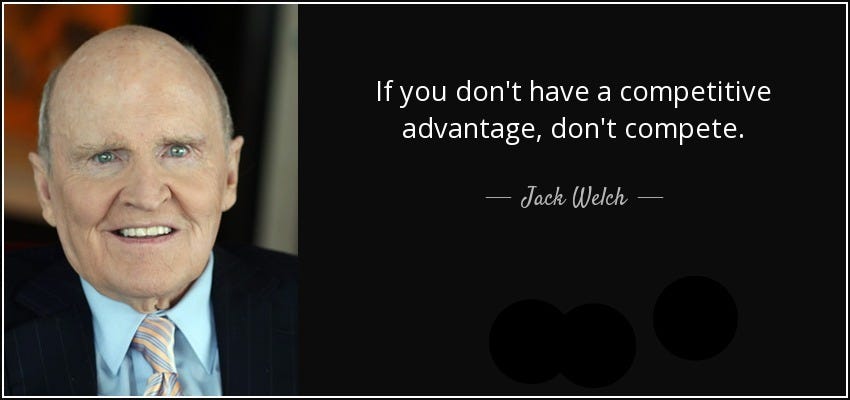
This principle directly applies to investing as it’s essentially a game.
It’s a game that we play to make money. The problem is that there are millions of other smart people playing the game, so it’s really hard to succeed.
There are institutions with all the resources in the world playing this game. Thus, it only makes sense that small investors will lose if they try to play the same game.
To succeed, we should play a variation of the game where we have competitive advantages. There are some structural sources of small-account advantage:
Long-term orientation changes the game as institutions frequently report back to their investors, thus they hardly accept short-term drags for long-term gains.
You can focus on smaller companies that wouldn’t move the needle for institutional investors, so they don’t buy and can’t buy in most of the cases.
Special situations where the market dynamics disfavour institutions.
One of these special situations where the market is tilted toward smaller investors is spin-offs.
Spin-offs are interesting because they have historically outperformed the index:
This was the case back in the 1990s and is still the case. But why? It’s structural.
Companies decide to spin off a subsidiary for a few reasons:
A subsidiary may be undervalued by the market, but being a different public company may allow the market to value it more efficiently and lift the valuation.
Subsidiary may be ignored in the parent; spinning it off would give it a dedicated and motivated management with an interest in the success of the company.
A subsidiary may be putting a drag on the parent company, and spinning it off can make the parent more stable.
The first two of these motivations are already bullish, so it wouldn’t be surprising to see them play out well. In the third case, the spin-off gets a toxic-waste treatment, and the price is driven down the toilet, so if they do even moderately well, the stock flies.
As Buffett says, everything could be a good investment at a low enough price.
So, if this structural advantage of spin-offs is well known, why do they persist?
The answer is also structural and can’t be undone, as the system is established this way. In most cases, spin-offs are done through stock or cash distributions to the investors of the parent.
In case of a stock distribution, owners of the parent end up with stocks they originally didn’t want. What do they do? They sell.
Institutions often can’t even choose to hold, as the spin-off often doesn’t qualify for them to hold. If the parent is a part of an index like the S&P 500, the spin-off isn’t automatically included in the index, so those who hold the index or only S&P 500 companies should sell anyway.
In the case of a cash distribution, very few of the parents’ investors go and buy the spin-off stock. They instead invest back in the parent.
All these create substantial pressure on the stock price, rarely allowing the spin-off stock to appreciate enough to erase long-term spin-off outperformance.
Thus, for smaller accounts, the spin-off space is an excellent fishing pond.
It’s even better when the spin-off company is already an exceptional company itself, though these opportunities are pretty rare.
Magnum is one of them.
It recently spun off from its parent, Unilever, and started trading as a stand-alone company in Amsterdam and New York exchanges.
The stock jumped by 30% in the first month of trading and then got hammered as holders saw this as a selling opportunity and dumped their shares:
It’s currently below the debut price.
This is the kind of special-situation opportunity that can drive meaningful returns in the current market environment, where growth is still overvalued across the board, and investors are rotating out of the US to global markets and from growth to defensives.
So, let’s cut the intro and dive deeper into the investment thesis.
What are you going to read:
1. 🏭 Understanding The Business
2. 🏰 Competitive Analysis
3. 📝 Investment Thesis & Catalysts
4. 📊 Fundamental Analysis
5. 📈 Valuation
6. 🏁 Conclusion
🏭 Understanding the Business
Peter Lynch once said, “never invest in any idea you can't illustrate with a crayon.”
Well, I am pretty bad at drawing, but I am pretty confident that even I can draw an ice cream. This is how simple Magnum is. It’s an ice-cream company.
If you scratch the surface, you see that it’s actually an ice-cream conglomerate that has grown to its current behemoth state over the course of a century through bolt-on acquisitions, organic launches, and greenfielding.
It started back in 1913, when an entrepreneurial butcher in London, Thomas Wall, decided to sell ice cream as nobody wanted to eat sausages under the summer heat, so his sales were plummeting.
In 1922, soap maker Lever Brothers acquired the business and started to scale it thanks to new commercial freezers coming from the US.
In 1930, Lever Brothers merged with the Dutch margarine maker, Margarine Unie. The logic was straightforward; both companies depended heavily on palm oil, so the merger would create significant synergies.
This way, Unilever became a conglomerate. Wall’s was the nucleus of the ice-cream unit of this new multinational conglomerate.
For the next 8 decades, Unilever’s ice cream unit expanded globally:
Cornetto, founded in 1959, was acquired by Unilever in 1976
Expansion into emerging markets in 1980 under the Heartbrand.
Magnum was internally developed and launched in 1989.
Acquired Popsicle in 1989, Breyer’s in 1993, and Ben & Jerry’s in 2000.
Talenti Argentine Gelato was acquired in 2003.
Yasso, a frozen Greek yogurt brand, was acquired in 2023.
This way, Uniliver’s ice-cream business has become the global leader, and this is exactly why Uniliver decided to spin it off.
As I said above, one of the most common reasons for spin-offs is that the subsidiary creates a drag on the parent company. This was the case for Magnum.
Before the separation of Magnum, Unilever was a consumer packaged goods conglomerate with 5 main divisions:
The problem was that ice cream was a very different business from the other four.
Beauty, personal care, and home-care products are more durable and have similar R&D and manufacturing processes, enabling significant synergies.
Nutrition and ice cream have similar R&D and manufacturing processes, but the business model and distribution are very different. Ice cream requires a dedicated frozen-supply chain. Plus, dry-nutrition products compete for the shelf-space while ice-cream competes for the point of sale by deploying freezers.
Also, the other four categories are not seasonal, while ice cream is.
This is why ice cream was historically underperforming and underinvested within Unilever. Plus, its seasonality and different overhead profile were putting a drag on the broader company.
This is why Unilever decided to separate the ice-cream unit in 2024 under the Magnum name, with plans to completely spin it off later on.
This would be mutually beneficial. Unilever would be able to focus on the businesses that had better synergies together, and Magnum would get dedicated management and capital to invest in growth.
Spin-off was completed last December, creating the largest dedicated ice-cream company in the world. Magnum currently has 21% global market share:
Ice cream was a €75 billion market in 2024 and expected to grow 3-4% annually through 2029. Given that we are looking at a mature market with established competitors and pretty stable market shares, the investment thesis for Magnum should depend on three things:
Its ability to preserve its market share.
Opportunities for expansion through above-market growth.
Catalysts that will drive multiple expansion and thus above-market returns.
I think all three exist in the case of Magnum.
Let’s start with why I think it’ll be able to preserve its dominance.
🏰 Competitive Analysis
In consumer goods, the single most important factor of success is the brand. As Warren Buffett says, a brand name owns a piece of the consumer’s mind.
Yet, this definition alone doesn’t explain the outstanding success of some brands and the mediocre market positions of others.
What do I mean by this? Well, both Coca-Cola and Snickers have some space in consumers’ mind but they are not in the same league. Why?
Because Coca-Cola has a repeat demand, but Snickers doesn’t. Coca-Cola has somehow locked in the demand, but the demand for Snickers is more sporadic and occasional.
Many people would say that it’s because Coca-Cola is so distinct and people are so used to it that they don’t want to switch. This, of course, has some truth to it, but even this stems from some structural advantages Coca-Cola created over time.
One thing we know is that when the alternatives are available, and it’s easy to create alternatives, people will eventually try new things, and markets will eventually become fragmented. This should tell you something—it’s very hard to create alternatives in the soda space.
It’s hard because the beverage business is essentially a distribution business.
Distribution is fragmented across millions of points of sale in the world. Big brands like Coca-Cola and Pepsi already have the brand, which creates the initial demand. If a seller doesn’t carry them, they lose sales.
To lock in this initial demand and make it repeat, Coca-Cola and Pepsi deploy fridges to their retail partners. Retailers cannot put a drink that is not included in these companies’ distribution scheme, so it’s very hard for a competitor to emerge.
Have you created a challenging cola formula? Good luck. A mom and pop retailer won’t buy it from you because they don’t have an independent fridge, and they can’t sell it in a Coca-Cola fridge. Nobody would want to buy a warm cola, so you won’t be able to gain traction, and without traction, big retailers won’t even bother to talk.
This is why it’s almost impossible to create a challenger in the soda space. The competition is not for the shelf-space but for the point of sale.
The ice-cream business mandates a similar distribution scheme due to the nature of the product. Brands provide points of sale with branded freezers to enable them to carry their products.
Thus, there is a competition for points of sale in the ice-cream business, and it is way more ruthless.
In sodas, it makes sense to carry the top 3-4 groups because consumption volume and frequency are very high, and you get a giant product range even by carrying just 3 brands, and consumption is non-seasonal.
This is not the case for ice cream.
Volume and frequency are lower, and consumption is seasonal. So, as long as you have the options, it makes sense to pick the top brand with the widest product range. It’s not worth it to put three different fridges in a mini-mart.
Thus, whoever has the largest network of freezers installed, it has a giant competitive advantage. In the ice-cream business, it’s Magnum:
Magnum has over 3 million freezer cabinets across the world. This is more than 2x the cabinet penetration of the closest competitor and over 3x that of the third company.
This is a huge moat.
It’s impossible to build this from scratch.
There are just a few reasons to switch between brands.
The market is mature, so it’s hard to take market share through faster growth.
On top of all these, incumbents have the brand power, so they have the initial demand to capture deployment opportunities in the new markets.
Thus, the market structure heavily favors the incumbents. We clearly see this on the numbers as well, since its market share has been largely stable for the last decade:
One thing I need to touch on here is the counterarguments about its competitive position.
I have seen some people on the internet suggest that its competitive position is not as strong as it’s thought because anyone can access co-packaging, refrigeration infrastructure, and premium artisanal brands are challenging it in Western markets.
This is the completely wrong way to think about it.
First, consumer goods are all about the mass market. By definition, premium markets are doomed to be fragmented; otherwise, they can’t position themselves as premium. And if the market is fragmented, no one will become big enough to undermine the incumbent in the mass market by going down the segmentation route.
Second, mass markets are about volume, and what drives volume is availability. Yes, you don’t need to deploy a freezer to enter a supermarket, but your availability will be limited. A consumer who could buy Magnum from a mini-market would likely pick the Magnum brand in a supermarket as well because of this availability heuristic.
Third, the revenue share of premium brands in Magnum across developed markets is growing faster than the segment itself.
This indicates that premiumisation is not a headwind for Magnum but a tailwind:
In short, Magnum has a very big relative market share in an otherwise fragmented market. This largely stems from its brand recognition and reinforcing this brand recognition with the largest installed base of freezer cabinets across the world. Further, the trend of premiumisation is benefiting it, not undermining it.
This is a rare spin-off with a definitive and durable dominance in its market.
However, the market is near maturity, so there shouldn’t be an expectation for fast growth, and those who follow this publication know that I don’t like investing in companies that aren’t poised for above-average growth, as growth is a constant source of catalyst that forces the market to re-rate the stock quarter over quarter.
So, what’s the thesis here if not the growth? What makes Magnum different? Let’s dig.
📝 Investment Thesis & Catalysts
There are several reasons I am attracted to Magnum despite its sub-par growth profile.
1️⃣ Spin-off Motivation and Insider Alignment
If you ever dipped your toes into the special situations space, you know that two of the most important things to look at in spin-offs are the motivation of the distribution and insiders’ actions.
It’s not uncommon for parents to separate a subsidiary to load it with debt and poor businesses. However, it’s also common that the company being separated may have real potential, as the parent company previously sought to acquire it or to grow it internally.
In the case of Magnum, it’s obviously the latter one.
Magnum is an established, market-leading business. In Unilever’s conglomerate structure, it was overlooked and couldn’t realize its full potential. We see this as the business was underinvested and lost market share until Unilever started to prepare it for separation:
Since they started thinking more seriously about the separation of this business in 2023, its market share climbed from 19.9% to 20.8%, and adjusted EBITDA climbed to €1.3bn. This shows that the business has the potential to do better, and it has a higher chance to achieve this under dedicated management with its own permanent capital.
The management also showed alignment with this vision as all the insider transactions except three have been purchases so far:
Insider purchases clustered around the €13-14 levels, though there were some even between €16-17.
The clustering of purchases at a certain level and spreading through time shows that they didn’t just buy to give a signal. After the stock touched near €17 and came below €14 once again, they kept buying, which means they sincerely believe the current price is cheap and the company will do better.
Chief of the US operations and Chief Human Resources Officers bought a total of 58,000 shares just last week. I think this shows that insiders truly see an upside from the current prices.
So, we have the most important things for spin-offs checked: Motivation and insider alignment.
What else?
2️⃣ Magnum is still poised to grow faster than the market.
As I have said, the global ice-cream market could be considered as mature; therefore, there aren’t that many opportunities for fast growth.
Yet, Magnum can still grow faster than the broader market and expand its market share. They are guiding for this.
The broader market is expected to grow by 3-4% annually, while Magnum guides for 3-5% annual growth:
This can be enabled by two factors.
I already mentioned the first one above. The premium segment is growing fast in developed markets, and Magnum is increasing its market share in the premium segment thanks to its brand power and wide range of brands.
The second factor is Magnum’s strength in emerging markets.
Emerging markets are growing twice as fast as the developed markets, and Magnum is dominating this market thanks to its early entry in Turkey, which it currently uses as a hub to expand into the emerging markets in Asia, Africa, and the Middle East.
Its largest competitor only generates 10% of its sales from emerging markets, while Magnum generates 30%. This is an early dominance that competitors won’t be able to shake for at least decades, as they are largely focused on premium segment in developed markets, and premium demand in emerging markets won’t ramp for years.
So, keeping a bit above market growth can trigger a re-rating by the market.
3️⃣ It has several catalysts ahead.
The second most important factor in spin-offs is the existence of catalysts. In the absence of catalysts, such slow-growing businesses can stay undervalued forever.
In the Magnum’s case, there are two important catalysts ahead.
The first one will be confirmation of the company’s operational profitability. The company reported that it generated €569M net operating profit in 2025, which corresponds to €0.93, but this was dragged down to €307M by separation and restructuring costs. As a result, net adjusted EPS for 2025 was €0.48.
Given that they are guiding for 3-5% top-line growth this year, their EPS should hit €1 after adjustments. The market knows this, but it’s skeptical whether we’ll really get this due to recent restucturing so the stock remains depressed at 13-14x this year’s earnings.
If they deliver, this alone will be a significant catalyst as it doesn’t make sense for a dominant, growing consumer staple to trade at 13-14x earnings.
The second catalyst is the dividend payment.
The company intends to pay out 40-60% of its net profit starting from 2027.
The company has 616 million shares outstanding, so based on a €1 EPS prediction for this full year, it’ll have a dividend yield between 3-4.6% next year.
Basically, assuming the current price persists, investors will get a globally dominant consumer business that is still growing with more than 3% dividend yield. This will attract many dividend chasers and dividend growth investors and will likely bump up the stock.
In short, we have a strong outlook and reasons to predict continuous growth for a dominant company. The management looks aligned, and the reasons for the spin-off favor the company. Plus, it has a couple of catalysts going forward that can bump up the price without much downside as it’s already trading at 14x this year’s earnings.
Everything looks favorable here.
📊 Fundamental Analysis
➡️ Business Performance
Unsurprisingly, Magnum’s performance has been flat since 2022, according to their registration statement.
Sales grew only by 5.4% since 2022, while net income has been stagnant if you exclude the seperation related costs in 2025.
If we were analyzing a company that promised growth, this would of course be a very negative picture, but it’s not for Magnum.
First of all, the fact that the business was able to generate consistent sales and income even when it was ignored within Unilever’s broader structure means that we’ll most likely get the income and cash flows promised by the management for this year, and it’ll work as a catalyst, as explained above.
Further, this means that the dividend promised by the company is also likely secure, so we’ll likely get another catalyst when dividend payments start.
Third, the business’ being able to deliver consistent performance even under Unilver shows us that they can do much better with a dedicated management, strategy, and capital.
Indeed, the management is guiding for growth above the market rate, and they are committed to cutting corporate bloat and costs.
In short, the performance tells us two things:
We can more confidently expect the catalysts.
There is upside if the management delivers on growth.
The downside is low, as the performance has been very consistent.
This is satisfactory for a spin-off like this.
➡️ Financial Position
Magnum’s financial position is quite healthy and not stretched for a first-class consumer business.
Before the consummation of the de-merger, it had around €300 million in debt.
However, in the company materials, they explicitly said that this debt figure would increase as they would have to get debt to pay for the asset transfers from the parent. The management said they were targeting a net debt/adjusted EBITDA ratio of 2.4-2.5.
In late 2025, they took on €3 billion in debt to pay for the asset transfers from the parent. Thus, net debt reached €2.96 billion:
Given that they reported €1.25 billion adjusted EBITDA for 2025, their net debt/EBITDA ratio is around 2.4, which is in line with the management’s promise.
This is a very manageable debt profile for a first-class consumer business with a very high earnings visibility. Theoretically, they still have room to leverage themselves to invest in growth.
Shareholders’ equity is around €625 million, less than debt, but this is largely irrelevant for a strong consumer company with predictable sales. If you look at strong consumer companies like Coca-Cola, you’ll see the same picture. They don’t need that much equity thanks to the consistency of the earnings.
➡️ Profitability and Capital Allocation
Margins
The company’s gross margin has been largely flat, confirming its competitive advantage as it means it doesn’t feel much pricing pressure. Though final gross numbers haven’t been disclosed for 2025 and I expect them to be announced with the full annual report, I don’t think it’ll be much different from the last three years:
Net margin tells a similar story. If it wasn’t for the one time seperation costs, net income would be €569 million and net margin would be 7.2%, which would be basically in line with the previous year and a slight expansion from 2022.
The margin profile of the business signals the two things that are the linchpins of this thesis—competitive advantage and stability.
Return on Invested Capital
The company’s ROIC is way above the satisfactory level. For the past three years, ROIC has been consistently above 18% while adjusted ROIC after stripping off one-time items has been abvoe 20%:
We don’t have the full annual report for 2025 yet, so we are missing some tax-related figures, but based on my calculation, adjusted ROIC will again be somewhere around 20%, which is in the ballpark of the management’s guidance.
The business is still deploying more capital year over year, and generating satisfactory returns on invested capital, so it’ll likely keep delivering growth even though it’ll be modest given the market saturation and already dominant position of the company.
In short, the fundamentals of the business are strong, and thus, there is not much downside from the current levels. So, it’s more likely than not we’ll get the upside when the expected catalysts hit.
📈 Valuation
The market valuation of the company is currently depressed due to a fresh spin-off, cloud over its real financials, and the deliverability of the long-term targets.
Magnum is currently valued at an EV/EBITDA of 8.40, which is a significant discount to the closest competitor, Froneri.
We don’t know the exact numbers for Froneri as it’s a private company, but we know that Goldman Sachs invested in October 2025 at a €15 billion valuation on an EBITDA of €1.2 billion. This gives Froneri an EV/EBITDA of 12.5, which is 50% premium on Magnum’s current valuation despite being a smaller company with similar growth.
Magnum also trades at a discount to other publicly traded consumer businesses:
Thus, if the catalysts we are waiting for come, I think it can easily jump up to the same valuation as froneri which indicates 50% upside from here with a very low downside.
Here, I should probably touch on two things that may still keep the valuation depressed.
The first one is the overhang problem.
Unilever still holds 19.9% of the shares, and it has committed to selling these shares in the next 5 years. So, investors are afraid that big blocks of shares will hit the market and take down the price.
I don’t think this is a problem. After all, the business has an intrinsic value regardless of who holds the shares. It’s perhaps this overhang that allows us to buy shares at the current discount, which is very attractive as illustrated by the management’s purchases and relative valuation.
Second is that many people are afraid that consumption may permanently decline due to the current demand for weight-loss drugs. However, note that weight-loss drugs are largely an American phenomenon and consumption outside America is not common.
The company estimates that weight-loss drugs may have only 0.5% effect on sales. I agree with this, as we haven’t seen a secular decline in the consumption of other sweets like Hershey’s bars.
In short, the valuation is attractive here for a swing trade and making quick profits between 30-50% if the catalysts hit as expected.
🏁 Conclusion
As I have said many times, at this stage of my investing career, I am not a big fan of special situations and deep value as they require fundamentally different approaches to portfolio construction and management.
Given that speculation is higher in these names, you are relying more on your predictions, you should have a larger portfolio and more diversification, and you should be quick in rotations. If you do these, they work very well.
I did these when I first started, but then switched to buying exceptional companies with exceptional growth profiles at attractive prices.
The problem is that there aren’t that many companies like that, most of those that exist are overvalued, and we already own many of those that aren’t overvalued.
Given that the market is also broadly overvalued now, I think it makes sense to broaden our horizon and look for other opportunities.
Magnum is an exceptional case as it’s a spin-off with a very-wide moat and heavy dominance in its market. Valuation is already depressed, and further downside is limited by its consistent performance. Thus, it offers an opportunity for a swing-trade when the catalysts we mentioned above hit.
Joel Greenblatt says spin-offs perform best following a full-year after the spin-off as the business economics start showing themselves.
There is still time until a year passes on Magnum’s spin-off, but the current price is already depressed enough, and it’s very unlikely that it’ll go further down from here.
Thus, I am ready to pull the trigger, but I will probably observe a bit more, waiting for the publication of the full annual report and maybe the first quarter results. The longer I can wait, the better it’ll be as the catalysts are clustered toward the end of the year, i.e, clarity on full-year results and dividend announcements.
I’ll pull the trigger at some point and look for a quick swing of 30-50%. You’ll know when I do it. Meanwhile, you can ingest the thesis, make your own research, and reach out to me if you see any red flags, etc.
I hope this helps.
That’s all friends!
Thanks for reading Capitalist-Letters!
Please share your thoughts in the comments below.
👋🏽👋🏽See you in the next issue!


I have a puny 2 shares from the spinoff. Maybe I should think about building a real position.
Superb Analysis 👍