It's Time To Rotate Into Platform Businesses
AI trade is about to hit its limits while dominant platform businesses are giving generational buying opportunities.
Occasionally, moments arise in the market that remind me of Charlie Munger’s famous saying:
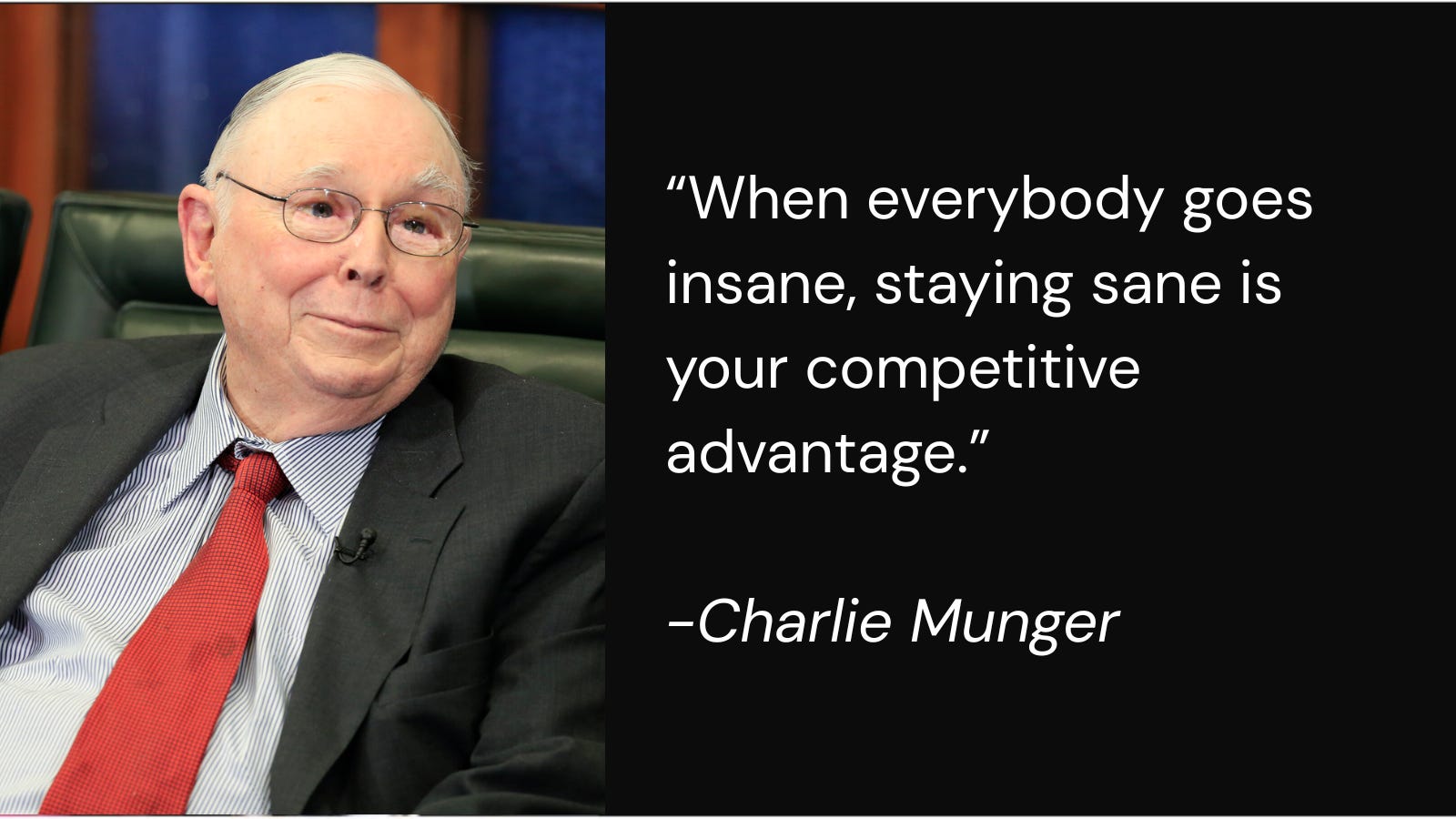
We are going through such times.
Since the beginning of the year, everything that can be somehow connected to the AI trade has skyrocketed, regardless of whether the connection promises real growth or not.
This isn’t something specific to now; it’s a characteristic of prolonged market rallies.
When the bull market lasts longer and goes higher than expected, those who waited on the sidelines get anxious as they start to think they may not get a chance to deploy money for a long time. They often decide to get into the market, but they are also aware that it’s likely closer to the end of the bull market than the beginning.
This pushes them to hunt for quick bangers. They don’t want to be stuck in the market in case of a drawdown, so they try to predict which stocks can go higher, rather than investing based on fundamentals. When this is the game, the natural answer is the themes that get the highest amount of capital inflows for this reason or that.
At the same time, those who have been in the market throughout the rally also start feeling that the bull market is about to come to an end. They also don’t want to be stuck inside, so they rotate from fundamental-driven long-term bets to quick money opportunities. They also rotate into the themes with the highest capital inflows.
This dynamic pushes these two groups into an already popular theme, making it even more popular. As a result, that theme sees an explosion of inflows, driving valuations to the skies while the rest of the market stays largely flat as capital is drawn away.
This is exactly what we have seen this year.
The fact that the S&P 500 excluding AI names has been lower since the beginning of the Iran War proves this:
This imbalance is approaching unsustainable levels.
After this recent rally, those AI-related names now make up 49% of the S&P 500, which trades at 29x earnings. Meanwhile, the equal-weighted index is trading at 23x. Meaning, AI names are trading at wild premiums to the rest of the market.
And this is just in the US large caps, the most followed companies in the world. When you look at small caps and foreign stocks, there are no limits to absurdity. You can easily find a semiconductor component manufacturer with no growth trading at 120x sales because it’s somehow tied to AI under the name of “bottleneck.”
This won’t last forever; nothing similar has lasted. So, the question is—when will it end?
When people no longer see money flowing into these themes, they will no longer put their own money in them.
The dynamic is simple. There is currently so much capex flowing into AI-related names that even a speculation about getting some of that money can attach significant optionality to a stock. This is fueled by increasing capex estimates as it makes space for new technologies, components, etc.
Indeed, we have only seen upward capex revisions since 2024:
When the capex estimates stop going up, and perhaps start declining, these speculative theses will hit a reality wall. Speculators will no longer be able to say “capex will go higher and a part of it will be spent on this technology.” Optionality will be quickly taken away from those speculative bets, and they’ll take a nosedive.
Not just them, even the real quality names will see a reset if capex stops going up.
Broadcom is a nice example here.
It’s an amazing business that is one of the backbones of the AI revolution. However, take a quick look at historical valuation, and you see that it’s priced on the assumption of ever-increasing capex:
Before 2023, Broadcom had a median sales multiple of 5; now it’s 25.
Analysts expect around $300 billion in sales in 2030, up from $69 billion last year. Even if we assume it hits these ambitious targets, re-rating to 5x will mean 17% downside from the current level. For shareholders to generate just 15% annual return, it should hit all the targets and still trade at 10x sales in 2030.
Given its historical valuation, a 10x sales multiple is possible only on the assumption of sustained growth beyond 2030, which depends on increasing AI capex.
If AI capex stops being revised upward, even Broadcom will be re-rated downward.
And we are about to hit the physical limits of it. For hyperscalers, the 2026 capex guide exceeds their operating cash flows in FY 2025:
This means they don’t have further room to aggressively grow capex, as free cash flow is about to become negative for all of them. We have already seen the signs of this as Google hit the equity markets to raise $80 billion, and META is considering the same.
The conclusion is that we won’t see aggressive revisions to capex estimates from now on, and those sky-high valuations that depend on upward capex revisions will come crashing down.
So, what’s the right thing to do here? Get out of the market and stay out until it all crashes down? No. The market can stay overvalued way longer than anybody can expect, and if you stay out all that time, you only get more FOMO every day, which leads to wrong decisions.
We have to notice that the money that has flowed to AI themes wasn’t created out of nowhere. It was drawn away from other parts of the market, naturally creating many opportunities in these spaces. We have to simply turn to those opportunities.
So, let’s look at the situation ahead and figure out the best place to be going forward.
The first axiom is that we want to be in fewer cyclical names, as the majority of the market is exposed to high cyclicality due to the capex boom.
We want attractive multiples, but we also want growth, so we can count on an eventual re-rating.
We want a wide moat so we can comfortably hold without worrying about a permanent loss of capital in case of a market-wide correction.
Inflation is ticking up again, so we want something that can easily pass costs to customers.
Looking at the current landscape, I see one specific group of companies that fit all these criteria: Multi-sided networks.
They have giant moats due to direct & indirect network effects. No dominant multi-sided platform has ever been disrupted so far.
They are less cyclical due to critical functions like mobility and hospitality. Their global scope also offsets cyclicality as one region may boom while another busts.
They automatically pass price increases as they often get a cut of the transaction volume between the other parties.
These companies were seen as ultimate compounders, and they are, so they often traded at a premium to the broader market. Naturally, when the AI boom started, they were storing excess capital, and that capital has flowed to the AI trade over time. So, the premiums of these businesses have eroded.
As the AI trade has been uninterrupted, nothing has happened so far to force capital to re-enter these stocks. Meanwhile, they kept growing, and thus many of them have become undervalued.
This is why I think it’s a very good time to rotate some capital out of the AI trade and into multi-sided networks.
I currently see five names that are especially attractive in this space.
1️⃣ DoorDash
It’s a multi-sided network connecting restaurants with customers.
It dominates the food delivery market in the US with over 60% market share. It’s also expanding in the UK and Europe with Wolt and Deliveroo.
DoorDash was one of the hot IPOs of 2021 that were priced well above their fundamentals at the time could justify. Then came the 2022 crash, and the stock went down by 83%, removing all the premium it got in the IPO.
Though it recovered post 2023, the high prices didn’t hold as the AI trade drained all the money out of these businesses. The business kept growing all this time, and as a result, multiples collapsed.
It’s currently trading at the lowest forward earnings multiple since it became public:
Meanwhile, analysts expect it to grow 18% annually by 2030 and revenues to reach $34 billion and net income to $6 billion. This means that it’s currently valued at 10x 2030 earnings, with high single-digit annual growth expectations between 2030 and 2040.
Beyond growth, there is another lever DoorDash can and will certainly pull—margins.
As for all multi-sided platforms, DoorDash's margins expand rapidly once the fixed costs are paid off. Current analyst estimates imply around 18% net margin in 2030. For mature multi-sided platforms, net margins can easily reach 25%. Yet, this was before AI. I think these platforms can now be run with a fraction of the developers they historically employed, thanks to AI. So, margins could easily go beyond 30-35%.
However, to be conservative, I won’t take the AI margin expansion scenario into account. Even if we simply assume high single-digit growth (9%) by 2035 and 25% net margin, we are looking at 5x 2035 earnings for a dominant platform business with decades of runway for growth.
The current price effectively implies the demise of the business somewhere in between 2030 and 2040, while it’ll likely stay as a growing company thanks to the structural drivers behind it, namely the volume growth and inflation.
Because of these, I think it should be re-rated.
A simple re-rating to 15x 2030 earnings will mean 40% upside to the current price.
I think this will happen over the next 6-12 months, since analysts will gradually carry their high growth estimates forward as the business exceeds targets this year.
So, due to recent business performance, dominant market position, and 40% immediate upside potential, DoorDash is an obvious opportunity to deploy money out of the AI trade right now.
2️⃣ Booking
This is one of the businesses the market struggles to price fairly. It was overvalued before Covid and was priced to death through Covid. After COVID-19 ended, it didn’t pull a V-shaped recovery as the FED started hiking rates and the market believed cyclicality would hit Booking.
It didn’t play out that way. Turned out that travel is way less cyclical now than the market used to believe, primarily due to the increasingly K-shaped economy. Most of those who could afford to travel in a low-rate environment could still afford it despite higher rates. The global scope of Booking also helped offset this cyclicality.
As a result, the business recovered to pre-COVID levels in 2022 and performed incredibly well since then:
The stock peaked in July 2025 at around $230 levels and has dropped by 30% since then. The good thing is that there is literally nothing that justifies this drop:
AI doesn’t promise anything new that it didn’t promise back then.
Long-term growth expectations for the company stayed stable.
Rates and the overall economic outlook have hardly changed.
So, here is what I think happened: The stock was likely in a natural drawdown after setting all-time highs. People were taking profits and reallocating to the AI trade. This sell-off was coincidentally exacerbated by the Iran War, as it’s guaranteed to negatively impact Q2 travel numbers.
That brought down the stock to as low as 14x forward earnings.
We can’t know the extent of the impact and whether it’ll be large enough for the business to miss the numbers or not. But anyway, the War is coming to an end as the US administration announced a deal, and any negative impact will completely subside over the next couple of quarters.
Thus, I don’t see any reason why it shouldn’t re-rate to its median forward earnings multiple of 20x since 2022. This should happen once the negative impact of the war completely subsides, i.e., over the next couple of quarters.
That re-rating promises a 33% upside from the current levels.
Given that the short-term disruption risk is too low and forward multiples are near record lows, a re-rating is near certainty. I am waiting for Q2 results to enter the stock, as the Iran War impact may weigh down on it again before the recovery starts.
3️⃣ Uber
Uber is the largest multi-sided mobility platform in the world, bringing together several multi-sided networks in a single business:
Its business performance has been exceptional since 2021 as revenues have grown by 30% annually since then, and the net margin has turned positive, reaching 15% over the last twelve months.
Yet, the stock has followed a very similar path to Booking and DoorDash. It peaked in late 2025 and has come down significantly since then:
All the factors that apply to DoorDash and Booking apply to Uber as well. Its drawdown was due in part to investors taking profit and in part to the market-wide rotation into the AI trade.
One discussion that revolves more often around Uber than other platform businesses like DoorDash and Booking is the risk of disruption by robo-taxis. I don’t think it has any teeth.
First of all, everybody should understand that Uber succeeded because it aggregated what’s historically been a fragmented commodity service. Currently, robo-taxis look no different than this. There are dozens of robo-taxi businesses active across the world, and there is no reason one should monopolize the market, as the technology is already widely available, and it’ll get only more accessible from here.
If the service is a commodity, why should it differ whether it’s provided by humans or autonomous AI systems? It doesn’t. Imagine we already have fragmented robo-taxi businesses. You download multiple apps to your phone to see which service is available for the lowest price. Don’t you think somebody would come up with an aggregator?
So, Uber is very well positioned to keep acting as a main aggregator of these robo-taxi businesses. Contrary to getting disrupted, this would significantly enhance Uber’s business efficiency as robo-taxis are more performant than human drivers:
There are two paths Uber can take here—either it could be a capital-light model where Uber simply aggregates different providers, or it could be a capital-intensive model where Uber deploys its own cars, buying them from a technology provider like Tesla or AVRide, etc.
The first model is obviously preferable. But even if others don’t accept that and Uber has to deploy its own vehicles, current projections suggest ~3 years of payback period and 20-25% operating margin after depreciation.
This is assuming a capex of $180-$220k per vehicle, based on the current prices. Prices will decline as the technology matures, so the future payback period will be significantly shorter, and margins will be significantly higher.
If this is the case for Uber, the current 10x earnings multiple on 2030 earnings, despite sustained double-digit growth projections beyond 2030, significantly undervalues the business. Re-rating to a more reasonable 15x 2030 earnings means there is 50% upside from here.
4️⃣ Grab
All the things we said for Uber and DoorDash apply to Grab as well, since it’s the blend of these two with dominant delivery and mobility platforms in Southeast Asia.
I would say Grab is better than both in terms of prospects because it also integrates a fintech business:
This allows us to assume persistent high growth for a longer period and higher blend margins. It has grown revenues by 47% annually since 2021:
Analysts expect 20% annual growth by 2028, which gives us $6 billion in revenues. Even if we assume 15% annual growth for 2029-2030, we’ll get $8 billion in revenues. Assuming a modest 20% net margin gives us $1.6 billion net income.
Given the current $13 billion market cap, it’s also trading at 8x 2030 earnings. Grab is younger, and its runway for growth is longer than DoorDash and Uber, thanks to the fintech angle, so it should actually deserve a higher exit multiple. However, even if we assume the same 15x earnings multiple, due to emerging market risk, we get around 85% upside potential to the current valuation.
5️⃣ American Express
Amex is not a platform like others, but it’s also a multi-sided network thanks to its closed-loop payment network:
It issues the card and credits, directly charging annual membership fees and interest to its users. It also processes the payment as the merchant is an Amex member as well, and charges him a commission based on the basket total.
The good thing with Amex is that it’s perennially undervalued compared to open-loop networks like Visa and Mastercard, as it has a bank angle due to being the card issuer as well. However, Amex is actually a better business model as it charges customers several fees, unlike a simple transaction fee charged by Visa and Mastercard.
American Express’ merchant fees are also higher than those of its competitors, as Amex customers tend to be more affluent and spend more. This makes it a great stock to hold through inflationary times, as its customers don’t cut back much on spending and basket totals increase with inflation, naturally lifting Amex earnings.
Thanks to this model, Amex’s growth has been very persistent at double digits.
For reference, Amex’s annual growth was around 10% when Buffett first bought it in 1963. It’s still around 10%:
Currently, it’s not as cheap as the other stocks in the list, trading at 16x next year’s earnings. Yet, I wanted to touch on it because it was around 15x forward earnings a few days ago.
Historically, buying Amex at or below 15x next year’s earnings has worked exceptionally well. Assuming 10% annual growth rate holds, at 15x next year’s earnings, the 5-year forward multiple declines to 10. As the business performs and growth assumptions are carried forward, the market bumps it back up to 15x in 12-24 months, promising around 20-22% annual return.
So, keep an eye on Amex as well.
If the stock drops to around 15x next year’s earnings, which corresponds to $300 levels, I would say it’s a no-brainer buy, promising 50% return in two years.
🏁 Last Words
The market has been defined by insanity over the last few months.
30-40% moves in a day have been normalized, multi-baggers are everywhere, and people are no longer satisfied with a decent 15% return.
Let me remind you, the historical annual average return of the market is just 10%. If you can do better than that, it’s really good. If you can do better than that for long periods, it’s elite money manager-level performance. And elite money managers are rare.
If you want to succeed in the market, it’s an imperative that you resist this insanity, remember that everything above 10% a year is pretty nice, and don’t chase what’s hottest to generate 100% return in a day. When everybody goes insane, staying sane is your competitive advantage, as Charlie says.
I guarantee you some people get rich in casinos, and I also guarantee you’ll go broke if you try that.
Some of the strongest businesses in the world, multi-sided networks, are trading at genuinely low prices because the money has systematically flowed out of them and into the AI trade, for no other reason.
Look at how similar their charts are, and you’ll understand this:
This is the money that has flowed into the AI trade seeking higher and faster returns. It’ll come back once the profit in the AI trade drains. It’s just a matter of time, not if.
You can take your position now at attractive prices, and expect something around 30-50% return within the next 12-24 months, as AI trade will hit the capex wall in this period. I know they look dull and feel like they will never move up. But all the winners feel that way initially, this is why there is a discount.
When I bought AMD in early 2025, it was thought to be trash. Same for Nebius, Oscar, and UnitedHealth, and many others.
The essence of investing is always the same. Buy good businesses when they trade at attractive prices. Last year, these were the likes of AMD and Nebius; this year, they are the platform businesses.
Hope this helps.
That’s all friends!
Thanks for reading Capitalist-Letters!
Please share your thoughts in the comments below.
👋🏽👋🏽See you in the next issue!


Great article Oguz on a sector which I'm underinvested. Actually I checked the Uber stock price this morning and thought "great long time chart, great execution yet we're at 52 weeks low"
Great article on platform business! I think there's a couple of things worth flagging though.
The DoorDash margin expansion argument (AI cuts developer costs to 30-35% margins) runs directly against the macro thesis. If AI lowers fixed-cost barriers for DoorDash, it does the same for challengers, and the moat narrows via the same mechanism that's supposed to widen margins.
And also on the capex ceiling: Google raising $80B in equity, which is cited as evidence FCF is about to go negative, actually proves capex can grow beyond operating cash flow if capital markets stay open. There's no physical limit on equity raises here, and I think its highly likely that other hyperscalers will soon follow suit. The real constraint is their return discipline, which hasn't been tested yet.