How To Really Have An Edge In The Market?
You don't need more information or knowledge.
I have been thinking a lot about this for the past few days:
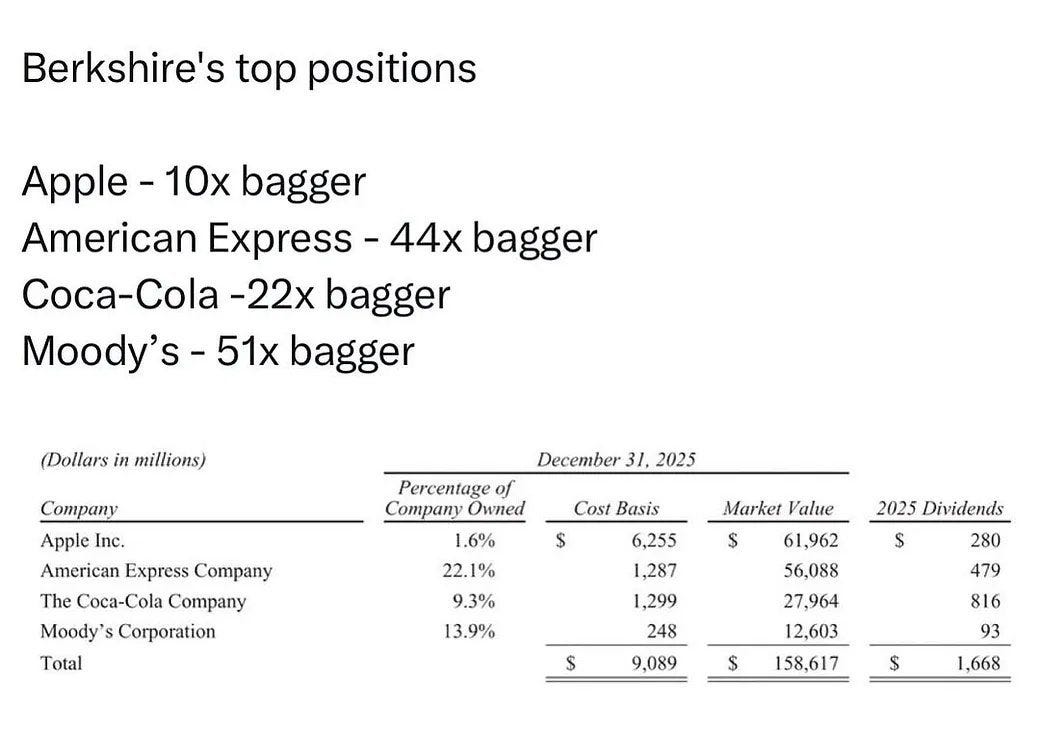
Buffett made 10x his money on his Apple position that he opened in 2016. When you say it this way, it sounds natural, but it’s not, as it was already the biggest company in the world when he bought it.
This is probably the biggest alpha ever created in a mega-cap by any investor.
And it’s not a one-time event for Buffett; it’s a pattern.
He has made 22x on Coca-Cola, 44x on American Express, and a mind-blowing 51x on Moody’s. The next time Moody’s doubles, he’ll have a 100-bagger, American Express goes up by 130% in the next 5-6 years, and he’ll have his second 100-bagger.
I am thinking a lot about this lately because of how hectic the market is, how tired every investor I see feels from trying to stay on top of everything going on, from the war to oil prices to inflation to AI, you name it, and trying to position accordingly, while in fact it’s this simple.
Now compare Buffett’s simple picture above with this:
85% of active large-cap managers underperform their benchmark in both the short and long term. What’s even worse is that 85% of all managers across all strategies underperform their benchmark in the short, medium, and long term.
The question is why? What does Buffett do that they don’t do?
It’s especially interesting to think about large-cap managers because they are operating in exactly the same space as Buffett. And in the large-cap space, there aren’t that many alternatives, so everybody knows almost all the alternatives, and many of those managers probably had many overlapping positions with Buffett at some point.
So, what was his alpha?
The stock-picking ability alone can’t be Buffett’s alpha. Indeed, he bought Apple when it was the largest company on earth. Because of the sheer size of his portfolio, he couldn’t buy hidden market gems. He bought Apple, and many managers bought it too.
What does Buffett do that others don’t?
It’s simple. Buffett didn’t try positioning based on macro headlines, geopolitical events, or try to predict the next bottleneck in an emerging technology and stocks to benefit from it. He didn’t care about short-term catalysts, 12-month price targets, etc.
Thus, a more interesting and deeper question is, why do people still do it? Why are both professional and retail investors almost maniacally trying to understand what’s going on now and forecast what’ll happen next?
For Wall Street, the structure of the industry is said to be the root cause. If you don’t do what others are doing and underperform, you are the problem, and clients withdraw their money, you lose management fees, etc. But if you do what others do and still lose, it’s the market.
That’s correct, but it’s only half of the picture. Why? Because retail investors don’t have this concern, but they are still trying to position according to headlines.
The decline of the average holding period is the living proof of this:
What has changed in the last 50 years that has pushed us to hold stocks for shorter?
It’s the technology. Information now disseminates at the speed of light. In the old days, you had to read a newspaper, do research by looking at manuals, etc., and think before you called your broker and put an order. Now we see the headline in news feeds a minute after the event happens, people instantly scroll on X to see the reaction, and can react within minutes after the event happens.
Naturally, the holding period declines.
This is the real question—why do we feel the need to position according to information, and whether it creates a genuine alpha?
This is what we’ll discuss today. We’ll try to answer three questions:
Why do we care so much about information?
Does information really create alpha?
The source of real edge in the market?
I hope this will give everybody a freshness of mind at a time when everything feels hectic. As Charlie Munger says, when everything goes insane, staying sane is your competitive advantage. We’ll achieve this together.
1️⃣ Why Do We Crave Information?
The short answer is that humans are suckers for information.
But why? It’s simple—because we are smart and we know it.
This is what distinguishes humans from all other species. We know this, and from our early days, we get an education that conditions us to make sense of the world by using our brains.
Thus, information gathering is indispensable for us. Without it, we wouldn’t survive. However, our information-gathering system is flawed because it creates a very early tendency to rely on information.
Why? Because the early information we gather is physical and based on practice. Thus, it’s almost 100% correct, and you always gain from relying on information.
Think about a little child touching a hot stove.
He gets burnt, and that information is solid, physical, and 100% correct. He knows that he’ll burn his hand again if he repeats the same action. He never touches it again and never gets burnt the same way.
The information is 100% correct, and it always provides an upside.
Early life is full of similar experiences, so we develop a very early tendency to rely on information. When we start a formal education, let’s say first grade, this tendency is almost absolute. How many of you remember questioning the things your teacher said in the first grade? No, we were taking her every word as 100% correct information.
The questioning is taught to us later in the formal education process.
Teachers push us to think about the questions they ask, they organize debates, and we are encouraged to ask questions and raise counterarguments to develop an independent brain.
So, most of the questioning is developed artificially in modern life. Our early information doesn’t leave much room for questioning because they are almost always correct.
As a result, the tendency to rely on information is very strong unless it’s mitigated by formal education. The problem is that formal education is naturally limited. Many people have only so much capacity to develop a deep understanding of a few topics through formal education.
Thus, whenever the topic is out of our expertise, the tendency to rely on information dominates. This blurs the chain of causation and leads to narratives often being perceived as correct information. This increases our confidence in the information and willingness to act on it, even though it was actually a narrative.
Thus, when we see hundreds of headlines in a day, we naturally tend to take them as information, as we can’t have expertise in all of the topics. Narratives replace truth, so we find ourselves urged to react to headlines.
It’s a chain that conditions us to crave information to act:
We don’t know the world when we were born, and we need information to live.
Our early experiences produce almost 100% accurate information all the time.
Accurate information creates a tendency to rely on what’s given as information.
Questioning is built later with formal education, and it’s strong only when we have depth of knowledge.
Out of expertise, causal chains are hard to distinguish from narratives.
When we can’t differentiate, we act with a tendency to rely on what’s given as information.
This is why we crave information.
Our life starts with uncertainty, and we get out of that uncertainty by gathering 100% accurate information. These conditions lead us to crave information when we face uncertainty again, but we lack the ability to distinguish real information defined by causal links from mere narrative in areas where we don’t have deep knowledge.
Thus, our tendency to crave and rely on information makes many narratives appear to be causation-based. Now, account for the fact that all the people feel and act in the same way. What happens? Narratives overwhelm accurate information by a magnitude.
Can you generate alpha relying on this and succeed in the market?
Let’s discuss.
2️⃣ Can You Generate Alpha Through Information?
There is a very dangerous and unfortunate trend I am currently seeing everywhere.
Substack is overwhelmed by deep macro research, thematic research, etc., and people are hopelessly paying for them to generate alpha and succeed in the market.
This idea is insane to me.
Let’s get to the basics, shall we? Macro funds posted their best returns since 2008 last year, and it still looked pretty miserable:
They achieved only around 16% after fees in a year where the S&P 500 returned 18%. If you invested with them since 2015, you are underperforming all major indexes by a margin.
Here is the question—don’t you think all these funds already had access to the top-quality research by Phds in relevant areas?
Of course, they had. The same applies to all thematic funds as well. They have always had the best research, best data, and best tools. They underperformed anyway.
Don’t get me wrong, the problem isn’t the researchers or the writers themselves. The problem is that both the writers and readers are falling into the same trap as I described above.
Writers are creating narratives and confusing them with causation because we all suffer from the same tendency to crave information in the face of uncertainty. Readers are taking what they wrote as accurate information due to the natural tendency to rely on information when the knowledge isn’t deep.
Result? Most macro-research is just narratives, and people are relying on it as if it were accurate information. Normally, it doesn’t work.
Daniel Kahneman provides one of the most solid examples of this phenomenon in his book “Thinking Fast and Slow”:
On December 13, 2003, after U.S. forces captured Saddam Hussein, Bloomberg News reported on the market reaction with the following headline:
13:01 Headline: “U.S. Treasuries rise; Hussein capture may not curb terrorism”.
13:31 Headline: "U.S. Treasuries fall; Hussein capture boosts allure of risky assets".
What Bloomberg did was just create narratives, not provide accurate information. As the headline incident suggests, you can’t generate any alpha from this, as narratives change all the time with perception.
If you bet believing Saddam’s capture wouldn’t curb terrorism, you would have lost money 30 minutes later as the sentiment changed and narratives evolved.
Accurate information is rare, and it tends to be priced in very quickly; all else is narratives that don’t reliably generate alpha.
In the example, Saddam’s capture was the accurate information, but once it was out, the market positioned itself accordingly. Thus, there are only two ways you can generate alpha from real information:
You are an insider, so you know it before others.
You speculate on the events.
In the former case, you are legally prohibited from acting on the knowledge. In the latter, I guarantee you’ll be more wrong than right and end up losing money.
So, the knowledge trap is real.
We build our knowledge mostly on narratives, like the Bloomberg headline above or macro-articles. Our evolutionary tendency to crave information in the face of uncertainty pushes us to take narratives as accurate information in the absence of real, deep knowledge.
The turkey problem illustrates this.
A turkey is fed for a thousand days before it gets slaughtered for Thanksgiving. Until the 1000th day, it thinks that he’ll be fed by the owner the next day, which looks like accurate information, probably the most accurate information in his life. But it’s actually wrong, and he understands this on the 1000th day:
The problem isn’t that accurate information doesn’t exist. It does; the owner knows the turkey will be fried on Thanksgiving, but the turkey neither knows it nor has any means to access that information; it’s within the owner’s mind.
It’s similar for the market movements.
Take Bloomberg’s headline incident above. There is, of course, a reason the market moved the way it did. If they could get into the minds of everybody active in the bond market, they would be able to present a clear picture, but this isn’t possible. So they drew narratives between phenomena.
This could be pretty harmless as the bond market may turn 1% up or down, but it could also be devastating, as in the case of turkey.
Thus, most of the information is useless in generating alpha.
Accurate information is useless because it’s already very well-known and priced, and narratives are useless because they just present a perception and are vulnerable to the turkey problem.
You can understand the uselessness of information by just looking at central banks.
They have all the accurate information, but they need to create the correct links between them so they can correctly speculate about the future, and we don’t get crashes or crises. Yet, they regularly fail to do it.
In a space where the institutions created literally for this job fail, you shouldn’t expect to generate alpha by reading macro-research or diving deep into geopolitical research to predict what comes next. This is illustrated by the macro funds themselves failing to generate alpha. How can you beat them by reading their research while they can’t beat the market?
A thematic AI basket may be doing very well right now, but it’s vulnerable to the turkey problem. What will happen when AI investments dry up? When will it happen, and what will trigger it? Nobody knows, but acting like it won’t happen makes you the turkey.
If you think anybody can see the next theme after AI, and the ones after that consistently, you are again being the turkey. Nobody has been able to do it so far, so why would this change know?
Michael Burry called the 2008 crisis correctly, but he also called the last 8 crises that never happened. He literally posted this in 2023:
The market is up 60% since then. This is not to throw a stone at Burry; it’s just to illustrate the impossibility of predicting market movements and themes based on research and the so-called “knowledge.” Because what it creates is not accurate information, just narratives.
I am sure Burry did a lot of research before calling a crash in 2023, but the links he created in his mind were wrong.
In short:
Accurate information is rare and tends to offer no alpha.
Most information is just narratives between phenomena.
Some links may seemingly work, but believing they’ll keep working makes you a sucker. You become a turkey.
So, if it’s not the information, what creates alpha?
3️⃣ Where Is The Edge?
If you get yourself into situations where you constantly need accurate information to navigate successfully, you’ll fail at some point because information space is dominated by narratives, not by accurate causations. This flows naturally from what we discussed so far.
Thus, the secret of success is getting yourself out of the situations where you need a lot of information and start operating where you need as little information as possible.
The less information you need, the better your ability to find accurate information and eliminate narratives that may or may not be correct.
When do you need as little information as possible?
It’s when you are buying something with a durable competitive advantage.
It has two components:
Durability: If you are sure that the business will be around 20 years from now, this eliminates a huge burden of information.
Competitive advantage: If you know that competitors won’t be able to take its business for some reason, you are unburdened from constant market analysis.
Thus, the real edge is not the information, but being able to rely on the lack of information. This is what Buffett is really good at.
Just listen to what he said about Apple:
He doesn’t know how the iPhone works or even its unit economics. What he knows is that people love their iPhone so much that they would give up on their second car rather than their iPhone.
This tells him that as long as we use mobile phones, it’s very hard for others to take Apple’s business. At that point, if you also believed that we would keep using mobile phones for the next 10-20 years, the only extra information you needed to invest was the fair value of the business. Then you would invest or not, depending on the price.
He basically eliminates almost all the need for information and makes decisions based on very little information.
Compare this with the information needs of a macro investor. He probably needs a daily flow of information on currencies, geopolitics, inflation, and employment numbers, etc. That creates an even bigger cloud of information as people interpret it and create narratives. It’s impossible to pick the right links consistently.
Buffett, on the other hand, needs no daily information from Apple, and even quarterly information doesn’t mean much given his mode of operation:
Durability
Competition
Price
Only price can meaningfully change substantially from quarter to quarter, while durability and competition require many more than one quarterly print to allow accurate observation.
As a result, he naturally starts with a longer initial holding period, which is prolonged if his thesis on durability and competition stands. His current average holding period for the top 5 positions that make up 70% of the portfolio is 20 years:
Don’t fall into the mistake of thinking Buffett is an exception in this.
What was the hedge fund that broke a profit record last year? It was Chris Hohn’s TCI. His average holding period is 8 years.
What allows him to do this is doing the same thing as Buffett—he eliminates the need for information by focusing on what matters.
What matters? Hohn says himself that 90% of the things don’t matter and what matters is competition and disruption, i.e., durability:
If you have that type of business, your need for information plummets, so you can think more clearly, hold longer as you are trying to observe very few things from prints that are 3 months away from each other, and sometimes 6 if you are investing outside the US.
That’s the real edge. Getting yourself into situations where the lack of frequent and accurate information doesn’t matter.
For example, two weeks ago I wrote a thesis about a fast-growing discount retailer in Mexico called TBBB. It’s simple to understand, has durability since retail business has been here for ages, and it has a competitive advantage as well, thanks to local economies of scale.
Compare it to drone defense businesses that are recently hyped, thanks to Israel having to use million-dollar missiles to take down $30k Iranian drones. A real asymmetry. People saw this asymmetry, of course, and reasoned that it shouldn’t be this way, and started to invest in companies that develop drone defense solutions.
One company that develops such systems is Aerovironment, which develops laser weapons to counter swarms. Now, put it next to TBBB and compare:
What company do you think requires more information to hold and manage the position? I am not saying Aerovironment is a bad business. It could be a really good business, but investing in it demands a constant flow of information and tinkering:
You should research what the counterdevelopments are.
You should understand what the alternatives are already here and in development.
You should research who really needs and buys it, and who develops their own etc.
These are just a few examples. It requires multiples of accurate information than a discount retailer, and it’s really hard to get accurate information to rely on, eliminating narratives dominating 90% of the information space.
In short, the edge is not access to more and more information and research; it’s distancing yourself away from situations where you need more information and getting into situations where you need very little information.
That’s how you succeed in the market, not by trying to consume every bit of information to stay on top of things.
🏁 Final Words
Most investors think that more information and knowledge are the key to success.
It couldn’t be further from the truth. If it were true, central banks would be very successful in preventing crises and shocks, but they haven’t been.
If the information were the key, researchers would make a bank, and Warren Buffett-Chris Hohn would be street sellers.
What you need is investing in things that require less information, not trying to get more information on hyped stuff.
This is really hard to do. Especially when there is a ton of competent-looking research getting published every day, one thematic investor winning one day and another the next day, and there is a constant stream of people who look like they have made money capitalizing on the information flow.
All those are illusions. The reality is this:
All these funds already have access to the best research and fastest information flow. The result is disappointment.
This is because information is not the edge. The edge is getting into things that don’t require too much flow of information.
Of course, the investment world will try to get you to believe the opposite. This is how the money is made. If you get into things that require more information, of course, you'd better have more and faster information. Otherwise, your returns would look even worse than the funds above. If you have cancer, you'd better get the chemo.
But the best thing you can do is to avoid cancer by eating healthy and doing regular exercise. In real life, that may not be enough, and you may still get cancer. But in investing, you always have the choice. If you don’t get on that path, nobody can push you onto it.
Always remember when you are bombarded with a constant flow of information and research: The real edge is not more information, but not needing a lot of information.
That’s all friends!
Thanks for reading Capitalist-Letters!
Please share your thoughts in the comments below.
👋🏽👋🏽See you in the next issue!


Great piece, Oguz. The Bloomberg Saddam headline example says everything — two opposite narratives within 30 minutes, both "supported" by the same event. That's the market in a nutshell.
We don't question information by default. Skepticism is a learned behavior, and even well-educated people revert to trusting narratives in domains outside their expertise. That's not a bug — it's how we're wired.
What you're really describing is a meta-edge: structuring your portfolio so that your edge doesn't depend on winning an information race you can't win. Most people never get there because the information flow feels productive. It's comfortable to feel "on top of things."
Most investors are optimizing the quality of their chess moves. Buffett changed the game — he only plays on boards where he already knows he won't lose.
Amazing piece, as usual