
Finishing July: Our Portfolio Outperforms S&P 500 by 25%, Here Is What We Own!
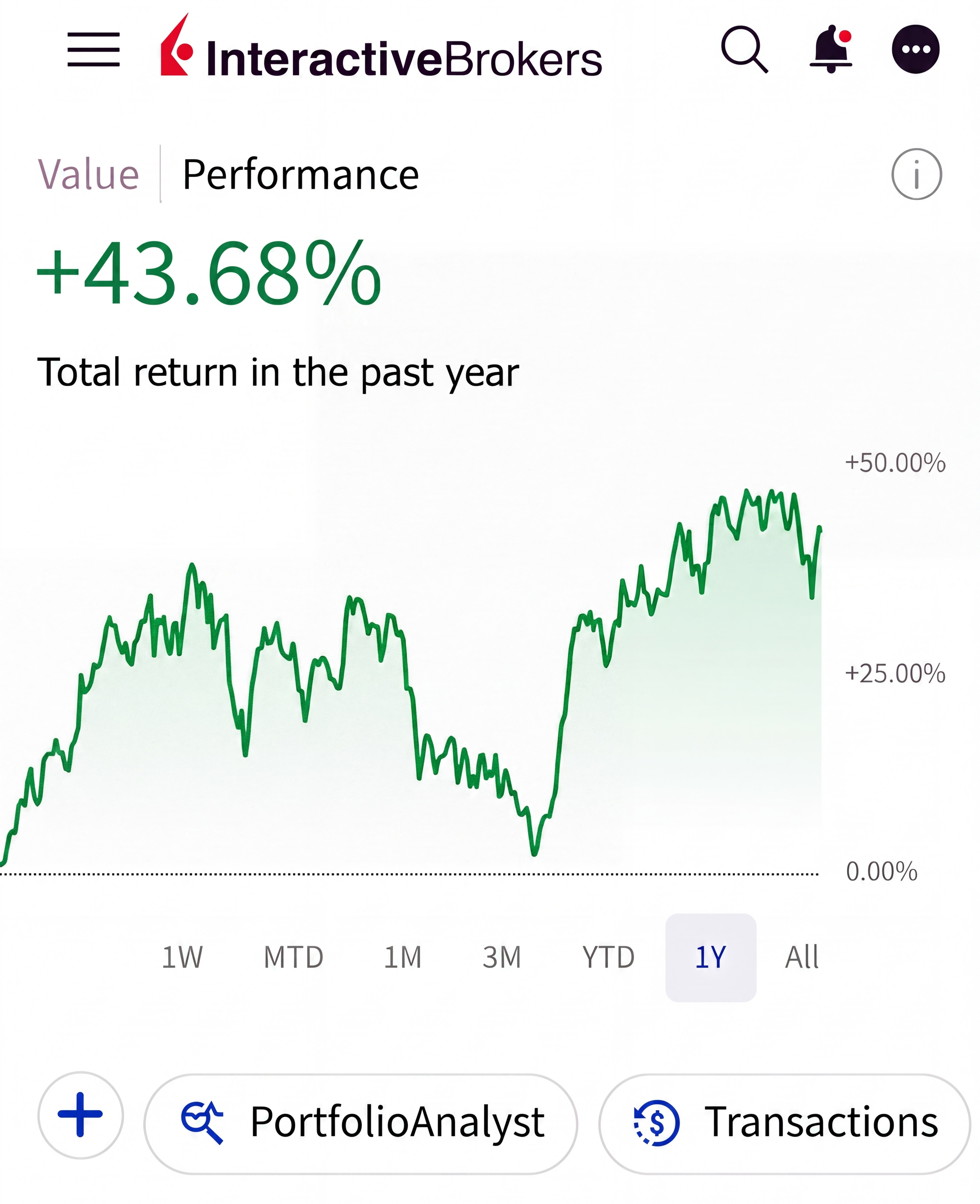
Portfolio is now up 43% over the last twelve months against 18% of the S&P 500!

💥Our portfolio is outperforming the market by 25%!
The portfolio is now up 43% over the last twelve months against 18% for the S&P 500!
If you have been following this publication for a while, you know that I emphasize in almost all monthly portfolio updates that observing your strategy work is more important than observing returns.
The last two weeks showed everybody why this is correct.
So, let me quickly explain what I mean by this because sometimes people can mistakenly think that it means strategy is more important than the returns.
This is obviously not true. Strategy exists for returns in the first place. What validates or invalidates a strategy is the returns it provides over time.
The key phrase here is “over time.”
What I suggest is that observing your strategy work is more important than the headline returns you see over the short-term.
The rationale behind this is simple: what you observe in the short-term isn’t the actual returns anyway; it’s the variance of the portfolio. Confusing short-term variance with actual returns is a common mistake investors make, especially in bull markets.
If you aren’t aware of this difference, you can easily make your portfolio vulnerable to variance.
How? Well, the most common way is leverage.
We have recently seen this with Leopold Aschenbrenner’s fund.
He went long AI, and it went very well when the sentiment about AI was very positive. It wasn’t all variance. Fundamentals of some companies he held improved substantially over the past two years, but they went up way more than fundamental improvement would justify. So, most of the upside was actually variance anyway.
He mistook this for actual returns and thought the price floors were higher than they actually were. So, confidently used leverage. When the sentiment turned, variance worked the opposite way; he got margin calls, and he had to sell all his public portfolio to Citadel at very low prices.
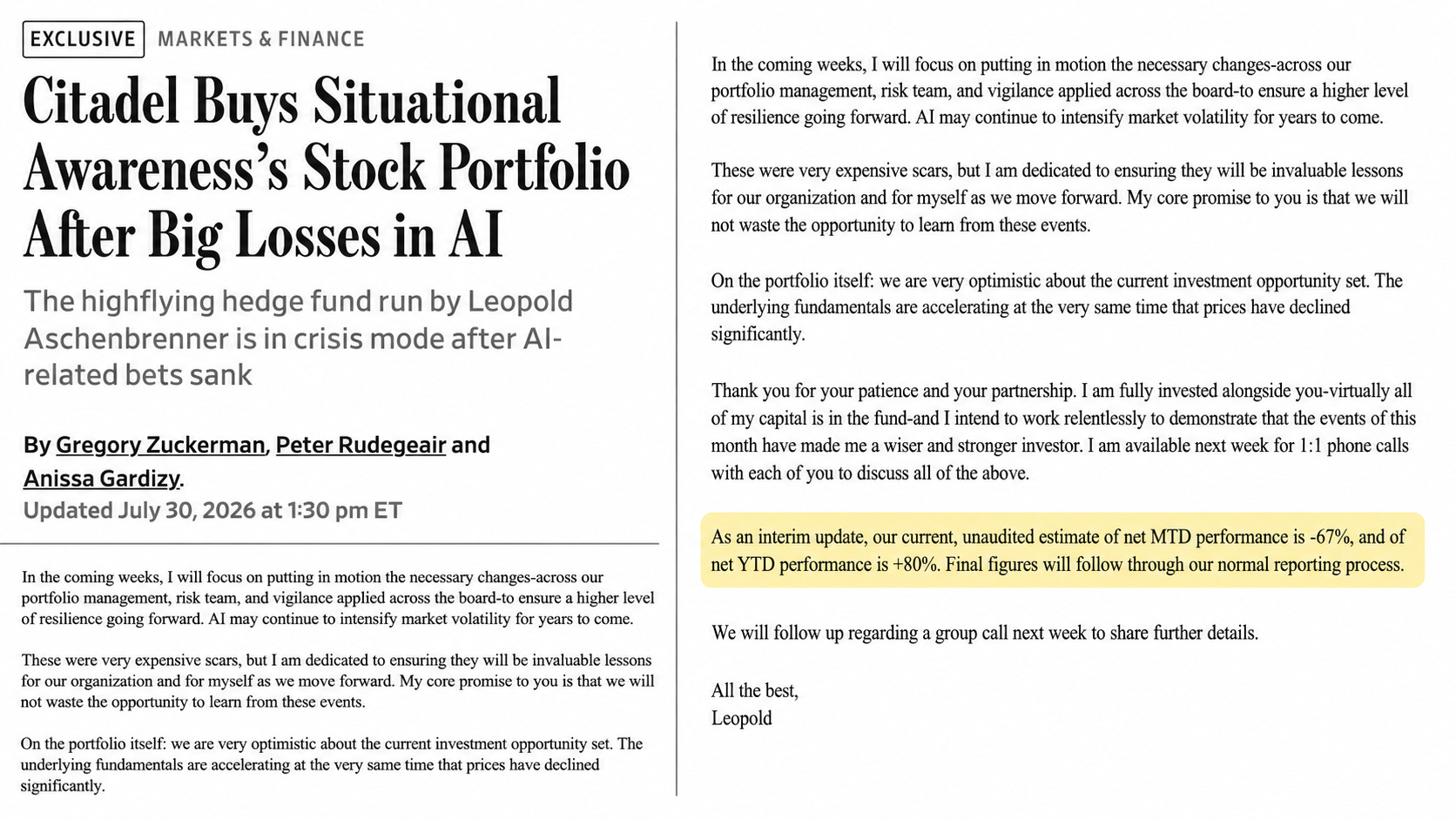
Though he tried to reassure his investors, saying the fund is still up 80% YTD, that gain is from the private positions. He essentially lost his entire public portfolio as his AUM shrank from $45 billion to $10 billion.
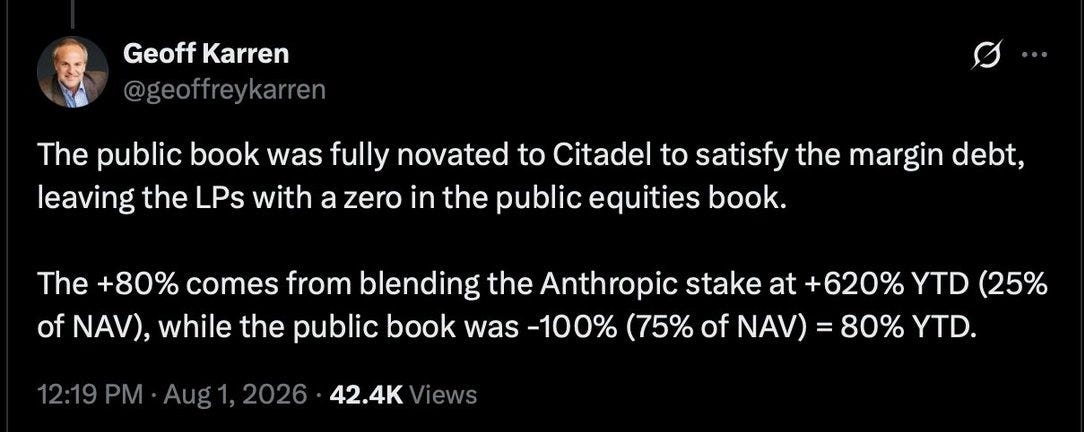
He failed badly investing in public markets because he mistook variance for returns and made one of the oldest mistakes in the book—leverage.
So, if the ultimate long-term arbiter of the strategy is returns, but short-term is largely variance, how do you observe whether a strategy is on course for the short run?
Well, you must have assumptions as to the effects of the moves you are making. You should have expectations, so you can observe.
You may expect the recent trades to limit portfolio variance, or you might have just made some opportunistic purchases in defensive stocks, so you can expect some alpha in downturns, etc.
The degree you’ll observe these will still be driven by variance, but you can still make fundamental observations from the direction and immediate reactions to market moves.
This is the most important thing. If the portfolio behaves the way you designed it to, then it’s a higher chance that it’ll also generate your target returns over the long-term.
In this sense, the fact that our portfolio is behaving the way it was designed to makes me way happier than the headline returns do.
Over the last few months, I shared with you some predictions about the portfolio:
One of our fundamental positions that lagged in 2025 would drive substantial returns this year.
We would generate alpha from small-caps as the market was concentrated on the US large-caps, so global small-caps were ignored more than usual.
Rotating from AI to platform business would work pretty well, as nothing changed in their moats, but the money left them to capitalize on the AI trade.
Thus, we positioned the portfolio accordingly.
We have kept that foundational position from 2025, bought four small-caps, and a platform company so far this year.
That foundational position is up 23% YTD.
Our average return on the small-caps we bought is now 34%.
The platform business we entered just in June is up 28% so far.
These headline numbers could be way lower since they include the variance, as I mentioned. But that would still directionally indicate that the strategy is working.
As a result of this strategy, our portfolio held up strongly. While Nasdaq slid into a correction, we were down by just 5%, on par with the S&P 500, despite generating way stronger returns on the upside. We are up 18% YTD against just 9% of the S&P 500 and 43% over the last twelve months against 18% of the S&P 500.
You can expect two things going forward from here.
The first one is definitely more small and micro caps.
Almost 41% of the market is now made up of mega-cap companies. This means that money from both within the US and global markets has flowed into the US mega-caps.
Currently, 10 big AI beneficiaries make up 40% of the market.
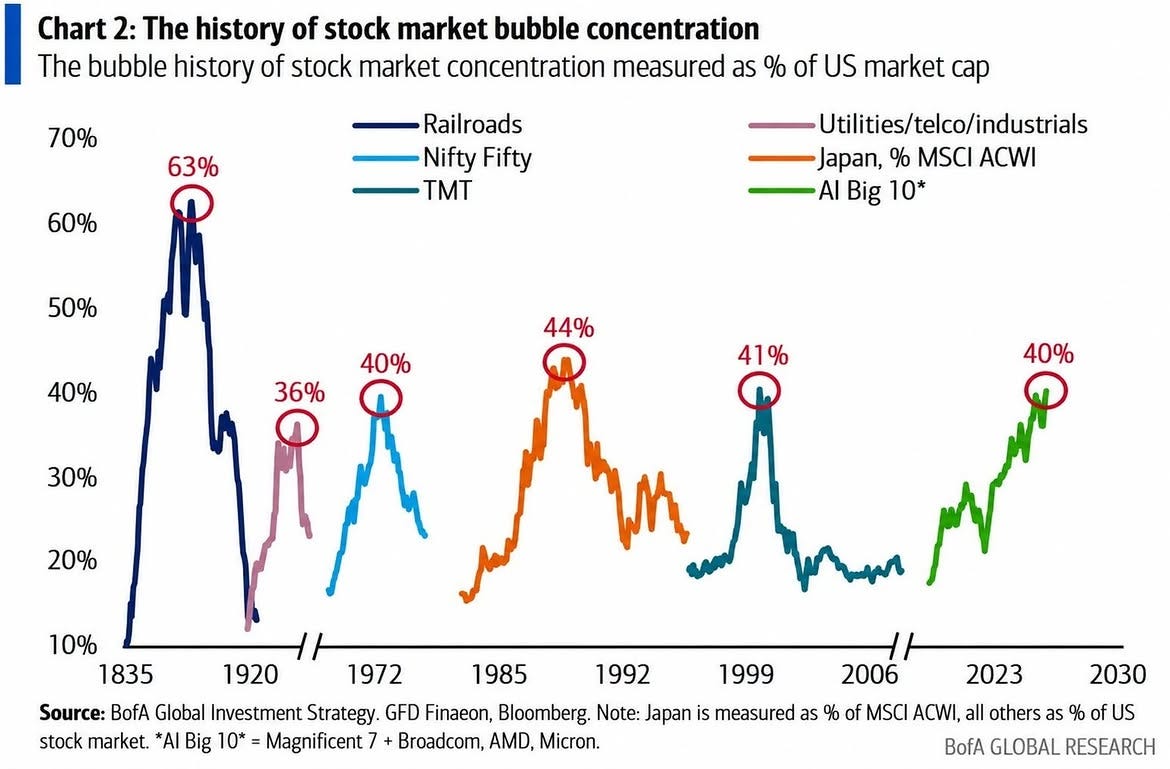
This reduced the effective number of S&P 500 companies to below 45, meaning less than 45 companies dictate the direction of the index.
Basically, liquidity has drawn from all other equities and flowed into these companies. As a result, inefficiencies in the other parts of the markets have increased. Small caps are affected even more as the liquidity in that part of the market is already thin.
As a result, there are many high-quality small-caps with a lot of potential that are trading at depressed valuations for literally no fundamental reason. So, as they come up with strong earnings, investors are forced to remind them so they receive acute capital inflows, bumping up prices and generating gains in a relatively short time.
Second, you can expect continued price and position discipline.
As we have seen with Leopold, riding the hype cycles and investing aren’t the same. They look similar until they don’t. Whenever you see a kid riding a hype cycle, buying on momentum, using leverage, and posting great returns, remind yourself there is a reason Warren Buffett, Charlie Munger, Peter Lynch, etc. didn’t operate that way.
I know that there are people following this portfolio, trying to make a few extra bucks on their hard-earned income, retirement savings, college funds, etc. And even though they first started as readers, I now call many of these people “friends.”
I would never invest in a way that would expose people who are trying to follow the portfolio and replicate returns to catastrophic risks. That sense of friendship weighs on my shoulders, never letting me even think about such degenerate moves. All my liquid capital is invested in the portfolio as well. I would never pull off Leopold.
We’ll always operate with the mantra of “limit the downside first, and the upside will take care of itself.”
This requires us to be intransigent on two things—quality and price.
We insist on having good businesses. We don’t aim to derive returns from a bad company becoming good. It rarely works. The company should already be quality.
And we insist on an attractive price. We are willing to pay a fair price for an exceptional business, but we won’t pay an exceptional price on the assumption that the business could become even more exceptional. No.
It’s simple, but it has worked exceptionally well for us so far:
Our portfolio is now outperforming the market by 25%!
The following transactions took place in our portfolio in July:
Exited 1 position.
Trimmed 1 position.
Increased 2 positions.
Opened 2 new positions.
In the previous updates, I provided my outlook for each company in the portfolio. Below, I’ll provide an outlook for our new positions as well and share overall portfolio commentary/strategy going forward.
So, let’s dive in.
🚨Our portfolio is proprietary to the members supporting the publication🚨
Members get portfolio updates every month!
Here is a 25% discount to celebrate new readers!
Valid only until Monday!
📊Here Is Our Full Portfolio!
As of today, we have 23 holdings in our portfolio.
10 of these positions can be considered foundational.